Emotional Intelligence EIQ + EIQ 360°

Invest in deeper personal awareness with the Emotional Intelligence self-assessment,
and compare it with observer data collected from colleagues,
managers, and direct reports. Transform your relationships
with the EIQ 360° assessment.

Gain Insight
Increase perspective
improve relations

The Heart of Success | EQ (EiQ 360°)

The smartest people aren’t always the most successful. Emotional Intelligence (EiQ 360°) is the differentiator. It measures your ability to recognize emotions in yourself and others, regulate your reactions, and lead with empathy. High EQ builds trust, strengthens relationships, and turns managers into leaders. And the best part, it’s a skill you can grow.
EiQ assesses your ability to recognize, understand, and manage emotions—both your own and others’—to improve relationships and performance.

EiQ 360° (Emotional Intelligence)

Align daily work with core values to stay energized and motivated

EiQ 360° assesses your ability to recognize, understand, and manage emotions, both your own and others’, to improve relationships and performance.

Strengthen leadership through empathy and emotional awareness

Handle conflict with confidence and composure

Build trust and influence through better interpersonal skills

Frequently Asked Questions About Emotional Intelligence and EiQ 360°

Emotional intelligence is the ability to recognize, understand, manage, and respond to emotions, both your own and other people’s.

That matters because work is not just tasks, deadlines, and skills. Work is pressure, feedback, conflict, trust, influence, disappointment, communication, and relationships. A person can be smart, talented, and technically capable, but still struggle if they cannot manage reactions, read the room, handle tension, or build trust.

Careerz Group uses emotional intelligence insight to help people understand the “heart of success,” the part of performance that shows up when people are under pressure, working with others, leading teams, or trying to grow.

The EiQ Emotional Intelligence Assessment helps you understand how well you recognize emotions, manage reactions, build relationships, communicate under pressure, and work with other people.

The value is not just knowing whether you are “emotionally intelligent.” The value is seeing where emotional habits may be helping or hurting your career, leadership, team relationships, influence, and trust.

If you have ever wondered why certain conversations go sideways, why feedback feels hard, why conflict drains you, or why people do not respond the way you expect, EiQ can help reveal the pattern.

Because career success is rarely just about choosing the right job. It is also about how well you handle the people, pressure, feedback, and relationships inside that job.

You may find work that fits your skills and interests, but still struggle if you avoid conflict, react defensively, misread others, over-personalize feedback, or fail to build trust. On the other hand, strong emotional intelligence can help you communicate better, recover faster, lead more effectively, and build stronger working relationships.

Careerz Group’s fit-first process looks at more than what you can do. It also looks at whether you have the awareness and relational skill to succeed once you are there.

Personality helps explain your natural tendencies. Emotional intelligence helps explain how well you manage yourself and relate to others in real situations.

That difference matters. A person may be naturally outgoing but still lack self-control. A person may be quiet but highly emotionally aware. A person may be analytical but miss emotional cues. A person may be warm but avoid difficult conversations.

Personality may describe your style. Emotional intelligence shows how effectively you use that style when people, pressure, and consequences are involved.

Yes. Emotional intelligence can be a major career accelerator.

Promotions are not based only on technical skill. They are often shaped by trust, communication, judgment, follow-through, influence, composure, and whether people believe you can handle more responsibility.

Many capable people stall because they do not see how their reactions affect others. They may be smart but defensive. Helpful but controlling. Passionate but intense. Careful but avoidant. Confident but dismissive. EiQ helps identify the patterns that may be limiting advancement before they become a career ceiling.

Yes. Conflict is one of the places emotional intelligence shows up fastest.

Some people avoid conflict until the issue gets bigger. Some react too quickly and damage trust. Some become quiet and hard to read. Some over-explain, defend, interrupt, shut down, or try to fix everything before they understand what is really happening.

EiQ can help you understand your emotional patterns under pressure, so you can respond with more clarity and less reactivity. The goal is not to become emotionless. The goal is to become more effective when emotion is in the room.

Yes. Leadership without emotional intelligence becomes expensive.

A leader’s emotional habits affect trust, morale, retention, accountability, feedback, decision-making, and team performance. People do not only respond to what a leader says. They respond to tone, timing, consistency, empathy, pressure, and whether the leader seems safe enough to be honest with.

EiQ helps leaders see where they may be building trust and where they may be creating friction. Stronger emotional intelligence helps leaders coach better, listen better, handle conflict better, and make it easier for people to do their best work.

EiQ 360° adds observer feedback to emotional intelligence insight.

A self-assessment shows how you see yourself. A 360° assessment adds feedback from people who work with you, such as colleagues, managers, direct reports, or other trusted observers. That outside perspective matters because most people judge themselves by intentions, while others experience behavior.

EiQ 360° helps identify the gap between what you intend and what others actually experience. That gap is often where trust, communication, leadership, and relationship problems begin.

A self-assessment gives you one viewpoint: yours.

EiQ 360° gives you a broader picture by adding feedback from other people. That matters because the way you think you show up may not match how others experience you.

You may think you are calm, but others may experience you as distant. You may think you are direct, but others may experience you as harsh. You may think you are giving people space, but they may experience you as unavailable. You may think you are being supportive, but others may need clearer direction.

EiQ 360° helps turn self-awareness into reality-based awareness.

Yes. Observer feedback is anonymous, which helps people give more honest input.

That matters because people are often more careful, vague, or polite when their name is attached to feedback. Anonymous feedback can reveal patterns people may not say directly, especially when the topic involves communication, pressure, trust, reactions, empathy, or leadership behavior.

The goal is not to embarrass anyone. The goal is to create a clearer picture so the person receiving the report can improve with better information.

The EiQ 360° report generates once at least three observer responses are submitted. You can invite more observers, and broader feedback can create a clearer picture of how your emotional intelligence shows up across different working relationships.

A strong observer group may include people who see you in different situations: a manager, peers, direct reports, project partners, clients, or trusted colleagues.

Do not only invite people who already agree with you. The value of 360° feedback is perspective.

EiQ is useful for anyone whose success depends on communication, trust, leadership, teamwork, influence, conflict management, or relationship-building.

That includes job seekers, career changers, managers, executives, founders, coaches, consultants, sales professionals, client-facing professionals, team members, and people preparing for advancement.

If you have ever received feedback like “work on communication,” “be less reactive,” “build stronger relationships,” “develop executive presence,” or “handle conflict better,” EiQ can help turn vague feedback into something more specific and actionable.

Yes. Interviews are not just information exchanges. They are trust-building moments.

A job seeker with stronger emotional intelligence can listen better, respond more thoughtfully, manage nerves, read the interviewer, handle difficult questions, and communicate value without sounding defensive or rehearsed.

EiQ can also help job seekers understand how they may come across under pressure. That is useful because the interview process often rewards people who can manage emotion, adapt communication, and build credibility quickly.

Yes. Team problems are often emotional intelligence problems wearing operational clothing.

A missed deadline may really be an avoidance issue. A conflict may really be a trust issue. A communication breakdown may really be a listening issue. A disengaged employee may really feel unseen, unsupported, or misunderstood.

EiQ can help teams build better awareness around reactions, empathy, communication, accountability, trust, and feedback. For managers and workforce leaders, that can support coaching, team development, leadership training, conflict reduction, and healthier collaboration.

EiQ helps answer the question: How do you manage yourself and relate to others when work gets human?

Careerz Group’s process looks at multiple layers because no single assessment explains the whole person. Job passion can clarify direction. Personality can explain tendencies. DISC can show observable behavior. Motivators reveal what fuels effort. HVP can reveal judgment. EiQ adds the emotional and relational layer.

That matters because even the right career path can become difficult if emotional patterns keep damaging trust, communication, or confidence.

EiQ helps turn self-awareness into stronger relationships and better performance.

EiQ is valuable by itself if your main goal is to improve emotional awareness, communication, trust, conflict management, or leadership presence.

But it becomes even stronger when paired with other assessments. DISC can show how your behavior lands. Motivators can reveal what drives your reactions. HVP can show how you judge and evaluate. JPTI can help clarify whether the work itself fits.

If you are trying to improve career direction, leadership, team performance, or professional growth, EiQ should be part of the bigger picture, not a standalone label.

Do not treat the report as a personality label. Treat it as a relationship and performance map.

Look for the patterns:

  • Where do you manage emotion well?
  • Where do you react too quickly?
  • Where do you avoid what needs to be addressed?
  • Where do others experience you differently than you intend?
  • Where would one behavior change improve trust, communication, or influence?

A strong next step is to review your results with a Careerz Group guide or coach and turn the report into a practical development plan. The goal is not to admire the insight. The goal is to use it in the next conversation that matters.

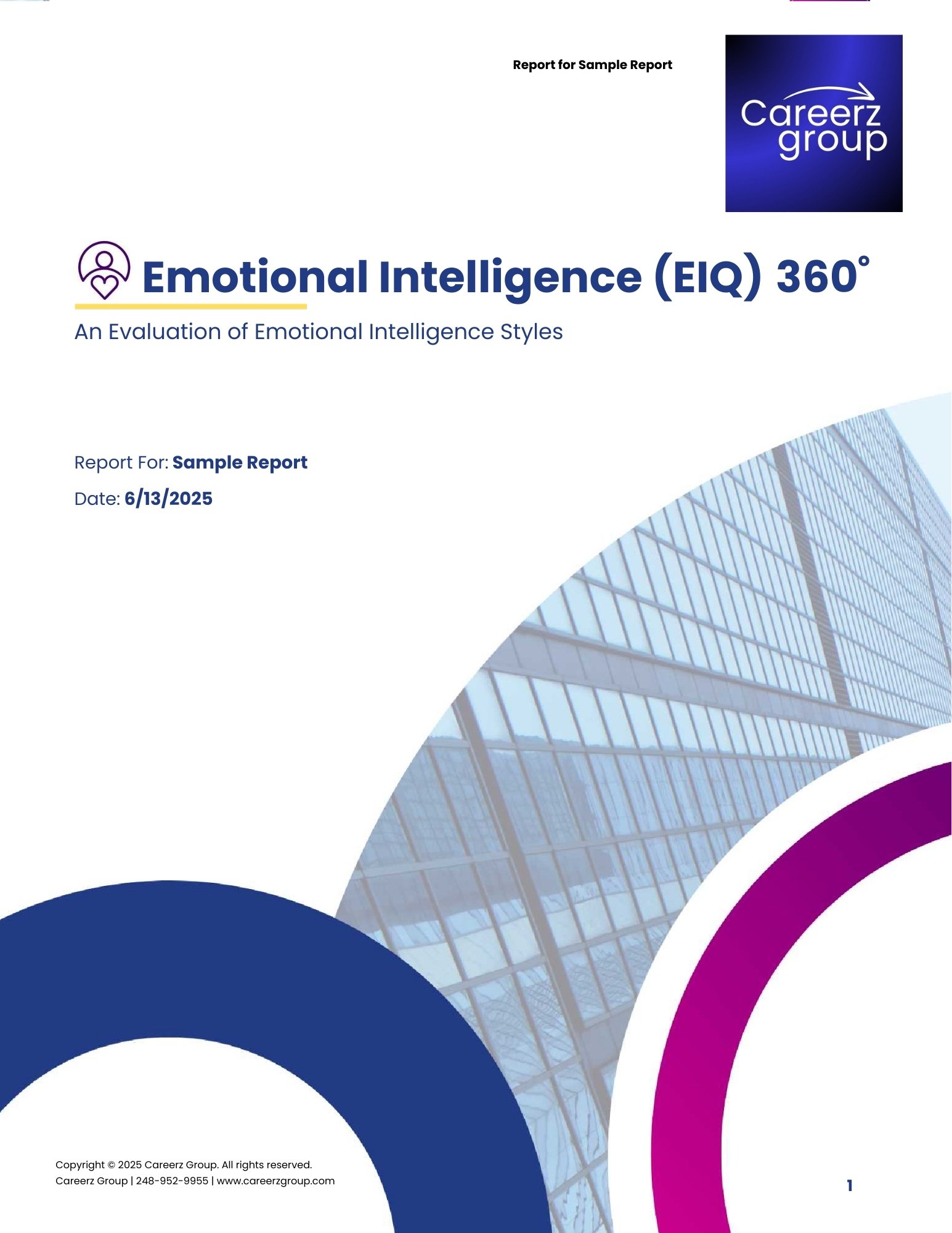
Emotional Intelligence (EIQ) 360° Assessment

The EIQ assessment looks at how your behavior affects people around you. Most of us think we know how we come across, yet there is often a gap between intent and impact. The EIQ 360° closes that gap with anonymous, honest feedback that shows how others actually experience you.

Even strong, self-aware leaders have blind spots. With a fuller picture, you can spot patterns, adjust your approach, and make sure your actions match your intentions. The result is clearer communication, stronger trust, and better outcomes with your team.

What is the benefit of a 360° assessment versus a self-assessment?
A self-assessment shows one point of view, yours. A 360° adds the perspectives of the people who work with you, which reveals the gap between what you intend and what others experience. With that bigger picture, you can adjust more wisely because you understand yourself and others at the same time.

EIQ 360° gives general themes, but I want specifics. How can I learn more?
Use the report as a starting point. Pick one or two themes, then ask colleagues for examples and context. Keep the conversation safe by showing real curiosity and a desire to understand. “When you picked this rating, what did you see or hear?” is a simple opener that invites helpful detail.

Is the feedback anonymous, and how many observer responses are needed?
Yes, feedback is anonymous. The report generates once at least three observer responses are submitted. You can invite as many observers as you like, and the cost is the same whether you have three or three hundred. More responses usually create a clearer overall snapshot.
EIQ 360° gives general themes, but I want specifics. How can I learn more?
Use the report as a starting point. Pick one or two themes, then ask colleagues for examples and context. Keep the conversation safe by showing real curiosity and a desire to understand. “When you picked this rating, what did you see or hear?” is a simple opener that invites helpful detail.

Is the feedback anonymous, and how many observer responses are needed?
Yes, feedback is anonymous. The report generates once at least three observer responses are submitted. You can invite as many observers as you like, and the cost is the same whether you have three or three hundred. More responses usually create a clearer overall snapshot.

Passionate – Dedicated – Professional

latest news & insights

We connect real-world labor trends, human behavior, and practical tools so students, parents, and professionals can make smarter decisions about work.
Every post is built to turn confusion into clarity and “someday” ideas into next steps you can act on today.