VARK™ |  Learning Style Questionnaire

Discover how you prefer to take in and share information.
So you can learn faster and communicate more clearly at work.

Visual
Learner

Auditory
Learner

Read/Write
Learner

Kinesthetic
Learner

How You Learn | Learning Styles

Everyone learns differently, and knowing your style accelerates growth. Tools like VARK reveal how you take in information, process experiences, and take action. Whether you learn best by seeing, doing, or collaborating, understanding your learning edge helps you adapt faster, work smarter, and thrive in any training or career development program.
VARK Questionnaire

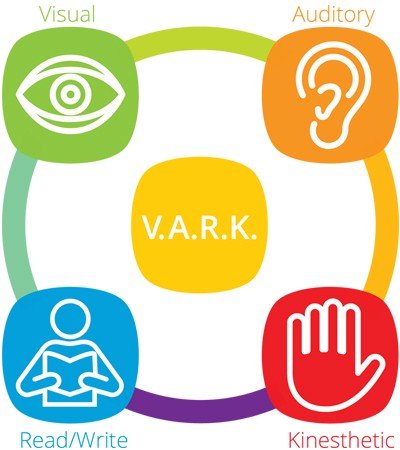
VARK identifies your preferred learning style—Visual, Auditory, Reading/Writing, or Kinesthetic—helping you absorb and apply information effectively.

> Learn smarter, not harder by using your best style

Improve retention by tailoring how you study or train

> Unlock faster skill development in school or at work

Three Primary VARK Styles

The VAK learning styles model suggests that most people can be divided into one of three preferred styles of learning. These three styles are as follows, (there is no right or wrong learning style)

Someone with a visual learning style has a preference for seen or observed things, including pictures, diagrams, demonstrations, displays, handouts, films, flipcharts, etc. These people will use phrases such as “show me,” “let’s have a look at that” and will be best able to perform a new task after reading the instructions or watching someone else do it first. These are the people who will work from lists and written directions and instructions.

Someone with an auditory learning style has a preference for the transfer of information through listening: to the spoken word of self or others, of sounds and noises. These people will use phrases such as “tell me” and “let’s talk it over” and will be best able to perform a new task after listening to instructions from an expert. These are the people who enjoy receiving spoken instructions over the phone and have the ability to memorize all the lyrics to songs they hear!

Someone with a kinesthetic learning style prefers physical experience—touching, feeling, holding, doing, practical hands-on experiences. These people will use phrases such as “Let me try” or “How do you feel?” and will be best able to perform a new task by going ahead and trying it out, learning as they go. These are the people who like to experiment hands-on and never look at the instructions first!

People commonly have a main preferred learning style, but this will be part of a blend of all three. Some people have a very strong preference; other people have a more even mixture of two, or less commonly, three styles.

When you know your preferred learning style(s) you understand the type of learning that works best for you.

There is no right or wrong learning style. The point is that there are types of learning that are right for your own preferred learning style.

Frequently Asked Questions About the VARK Learning Style Assessment

The VARK Learning Style Assessment helps you understand how you prefer to take in, process, and use information.

VARK stands for Visual, Auditory or Aural, Read/Write, and Kinesthetic. These learning preferences can shape how you study, train, communicate, remember information, and build new skills.

At Careerz Group, we use learning style insight as one more layer in the fit-first process. It helps answer a practical question: How do you learn best when you actually need to apply something?

Because career growth usually requires learning something new.

You may need to learn a new role, new software, a new industry, a new communication style, a new leadership skill, or a new way to present yourself in interviews. If you do not understand how you learn best, you may mistake a poor learning method for a lack of ability.

That matters for students, job seekers, career changers, leaders, and people returning to work. The issue may not be that you cannot learn it. The issue may be that the information is being delivered in a way that does not help you absorb and apply it.

The four VARK learning styles are:

  • Visual: learning through diagrams, charts, images, spatial layouts, maps, and visual organization.
  • Auditory or Aural: learning through listening, discussion, explanation, conversation, and spoken instruction.
  • Read/Write: learning through written words, notes, lists, handouts, articles, manuals, and text-based material.
  • Kinesthetic: learning through doing, practicing, touching, building, moving, experimenting, and real-world examples.

Most people are not only one style. Many people have a blend. The goal is not to force yourself into a label. The goal is to know which learning methods help information stick.

No. VARK can help in school, but it is not only for students.

Adults are constantly learning at work. They learn through onboarding, training, meetings, coaching, leadership development, sales scripts, new systems, compliance processes, job transitions, and professional development.

If the learning method does not match how someone absorbs information, training becomes harder than it needs to be. VARK helps people and organizations make learning more practical, easier to retain, and easier to apply.

Yes, if you use the results to change how you study, train, or practice.

A visual learner may need charts, mind maps, and visual examples. An auditory learner may need discussion, explanation, or repetition out loud. A read/write learner may need notes, outlines, and written instructions. A kinesthetic learner may need hands-on practice, examples, simulations, or trial and error.

The goal is not to work harder with the wrong method. The goal is to work smarter with the method that helps your brain turn information into usable skill.

It can help, but it should not be used as the only decision tool.

VARK can help students understand what kinds of classes, training environments, study habits, internships, and work settings may help them succeed. A student who learns by doing may need hands-on programs, labs, apprenticeships, simulations, projects, or internships. A student who learns best through reading and writing may thrive in programs with strong research, writing, analysis, or documentation.

But learning style is only one part of fit. Careerz Group also looks at work-fit, values, motivators, behavior, personality, strengths, goals, and real-world role demands.

VARK helps answer how you learn. It does not fully answer what work will fit your life.

Yes. Job seekers are often learning under pressure.

They may need to learn how to describe their value, tailor a resume, prepare for interviews, understand job descriptions, research companies, use new technology, or build confidence after a setback.

VARK can help a job seeker choose better preparation methods. A visual learner may benefit from interview maps or role-comparison charts. An auditory learner may benefit from mock interviews and verbal rehearsal. A read/write learner may benefit from written scripts and bullet-point prep. A kinesthetic learner may need live practice and role-play.

The right preparation method can make the job search feel less scattered and more controllable.

Yes. Career change requires learning a new language, not just making a new decision.

A career changer may need to understand a new industry, translate past experience, close skill gaps, learn new tools, rebuild confidence, and communicate their value to a different audience.

VARK helps identify how that learning process should be structured. If you know how you absorb information, you can choose better courses, coaching methods, practice tools, training formats, and accountability systems.

That can reduce overwhelm and help the pivot feel more actionable.

Yes. Training fails when the delivery method does not match how people actually learn.

One employee may need a visual workflow. Another needs a checklist. Another needs someone to explain it out loud. Another needs to do the task with guidance.

If everyone is trained the same way, some people will look slower, less capable, or less engaged than they actually are. VARK can help managers, trainers, and workforce leaders build training that is easier to understand, easier to remember, and easier to apply.

Better training is not just more content. It is better transfer.

VARK can help managers communicate instructions in ways people can actually use.

A manager may think they explained something clearly, but the employee may need a diagram, written steps, a walkthrough, a recording, or a chance to try it hands-on. When managers understand learning preferences, they can reduce repeat questions, confusion, frustration, and avoidable mistakes.

For teams, VARK can also improve meetings, onboarding, project handoffs, documentation, training, and coaching. The practical question becomes: How do we make the information usable for the people who need to act on it?

It should not.

Bad use of VARK says, “I am only a visual learner, so I cannot learn any other way.” That is not the point.

Smart use of VARK says, “This is my strongest learning pathway, and I can use it to support the others.” A visual learner may still need to read. A kinesthetic learner may still need instructions. An auditory learner may still need written notes. A read/write learner may still need practice.

The goal is flexibility, not limitation.

That is common.

Many people are multimodal, meaning they use more than one learning preference. That can be an advantage because it gives you more than one way to absorb and apply information.

The key is to notice which method works best for the situation. Some tasks may require reading. Others require practice. Some concepts are easier with diagrams. Others are easier through conversation.

VARK helps you become more intentional about choosing the right learning method for the task.

VARK helps answer the question: How do you learn and apply new information?

Careerz Group’s process looks at multiple layers because no single assessment explains the whole person. Job passion can clarify direction. Personality can explain tendencies. DISC can show communication and behavior. Motivators reveal what fuels effort. Critical thinking reveals judgment. Emotional intelligence shows how you manage yourself and relationships. VARK adds the learning layer.

That matters because even the right career path requires learning, adapting, and growing. VARK helps make that growth more efficient.

VARK is useful by itself if your main goal is to improve study habits, training, retention, or skill development.

But it becomes more powerful when paired with other Careerz Group assessments. DISC can show how you communicate. Motivators can reveal what drives effort. HVP can show how you judge and evaluate information. Emotional intelligence can show how you respond under pressure. JPTI can help clarify work-fit and direction.

If you are trying to make a serious career, school, training, or workforce decision, VARK should be one part of a bigger picture.

Do not just say, “That is my learning style,” and move on.

Use it. Change how you prepare, study, train, take notes, ask questions, practice, and review information.

Ask:

  • Where am I trying to learn the hard way?
  • What format helps information stick?
  • What kind of practice helps me apply it?
  • Where do I need visuals, discussion, written steps, or hands-on repetition?
  • How can I use this insight in school, work, interviews, training, or coaching?

A Careerz Group guide or coach can help you connect your learning style with your broader career roadmap, especially if you are choosing a path, changing direction, building new skills, or preparing for advancement.

Passionate – Dedicated – Professional

latest news & insights

We connect real-world labor trends, human behavior, and practical tools so students, parents, and professionals can make smarter decisions about work.
Every post is built to turn confusion into clarity and “someday” ideas into next steps you can act on today.