DISC™ Assessment
(D)ominance, (i)nfluence, (S)teadiness and (C)onscientiousness

The DISC Assessment™ reveals your behavioral style and communication preferences
so individuals and teams can adapt faster, reduce friction and deliver better results.

Communication Unlocked

Clarity • Adaptability • Trust

Leadership Elevated

Coaching • Motivation • Influence

Teamwork Accelerated

Collaborate • Align • Productivity

Reduce Friction, Raise Results.

Map Your DISC Style to Accelerate Your Career Path.

Predictable Collaboration = Better Outcomes
At Careerz Group, the DISC Assessment™ helps you decode how you naturally show up at work: how you communicate, make decisions, and collaborate. The result is less friction, clearer strengths, and confident growth. You’ll receive a clear profile with practical next steps you can use right away.

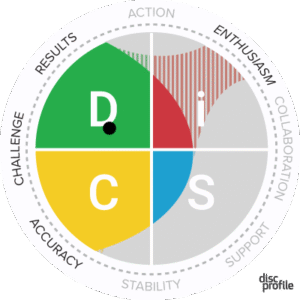
DISC maps behavior across four observable styles: Dominance, Influence, Steadiness, and Conscientiousness. Everyone is a unique blend. Knowing your mix explains why some conversations feel easy while others do not, and it gives you a roadmap to stronger teamwork, clearer communication, and higher productivity.

45M+ people across 75+ countries have used DISC

Reliable by Design.
Trusted at Scale.
Improve Self-Awareness.

Building a company or a career plan?
DISC helps with team development, communication, and coaching.

What you gain

  • Clear picture of your primary and secondary styles.
  • Playbook for adapting your communication to different people.
  • Tactics to reduce friction and speed up decisions.
  • Language for coaching conversations and career growth.

85% Accuracy reported by 45M users

Used since 1956, each year over 1 million people take DISC assessments, reporting an aggregate 85% accuracy.

95% of people think they’re self-aware. At best 15% are.

Only 10–15% of people are truly self-aware, which means there is real room to grow. Source: Harvard Business Review

How others view you impacts your career advancement

If how you’re seen is holding you back, DISC reveals why and gives you the tools to reset the narrative.

When reputation lags behind reality, DISC helps you reframe, adapt, and move forward with momentum.

You may be saying the right things, but they hear something else; DISC bridges that gap with practical steps.

DISC shows how you approach tasks, solve problems, and connect with others. It’s the practical blueprint for your everyday style of working and leading.

Students & Starters

Find Your Voice Fast
DISC shows how you speak, listen, and collaborate. Use it to shine in interviews and nail team projects from day one.

Mid-Career Professionals

Influence Without Strings
Spot the habits that let others steer your day. Use DISC to adapt across stakeholders and keep projects moving forward.

Sequel and Encore

Unchain Your Next Act
Reset how you’re received and build trust fast. Use DISC to make your experience land where it matters most.

Frequently Asked Questions About the DISC Behavioral Assessment

It is not trying to explain your whole personality, your intelligence, your values, or your potential. It shows how you tend to communicate, respond to pressure, approach problems, influence others, handle pace, and work with structure. That matters because your career is not only shaped by what you mean. It is shaped by how other people experience you.

At Careerz Group, we use DISC to help people close the gap between intent and impact. You may think you are being efficient, careful, helpful, or direct. Someone else may experience you as rushed, rigid, vague, intense, passive, or hard to read. DISC gives you a practical way to see that gap and adjust before it costs you trust, influence, or opportunity.

Because your reputation often moves faster than your résumé.

People make decisions about you based on how you show up in meetings, interviews, emails, conflict, projects, deadlines, and everyday conversations. If your style is misunderstood, you may be passed over, underestimated, avoided, micromanaged, or labeled unfairly.

DISC helps you understand the signals you may be sending without realizing it. That is why it can be so valuable for job seekers, employees, managers, salespeople, career changers, and leaders. It helps you stop guessing and start communicating with more intention.

Personality assessments help you understand internal tendencies. DISC focuses on observable behavior.

That distinction is important. Personality may explain what feels natural to you. DISC helps explain what other people can actually see: your pace, directness, openness, patience, urgency, structure, flexibility, and response under pressure.

Careerz Group uses DISC after deeper fit-based assessments because even a great career match can become frustrating if your communication habits create avoidable friction. DISC helps turn self-awareness into better conversations, better collaboration, and better outcomes.

DISC stands for Dominance, Influence, Steadiness, and Conscientiousness.

Dominance is often associated with directness, challenge, results, and problem-solving.

Influence is often associated with energy, persuasion, enthusiasm, and connection.

Steadiness is often associated with patience, consistency, support, and cooperation.

Conscientiousness is often associated with accuracy, structure, quality, and careful analysis.

Most people are not only one style. They are a blend. The value is not in saying, “I am a D,” or “She is an S.” The value is understanding how your style blend affects communication, trust, decisions, conflict, and follow-through.

Yes, especially if your work depends on communication, influence, leadership, collaboration, client relationships, interviews, or cross-functional teamwork.

Many capable people stall because their style is working against them. They may be smart but too blunt. Helpful but too indirect. Detailed but too slow to decide. Energetic but hard to follow. Steady but too quiet about their wins. Analytical but difficult to read.

DISC helps you identify the behavioral patterns that may be helping you, and the ones that may be holding you back. At Careerz Group, that is the practical value: use DISC to adapt your style without losing yourself.

Yes. DISC can help you read the room and adjust your message to the person in front of you.

A direct interviewer may want concise proof, outcomes, numbers, and ownership. A relational interviewer may care more about teamwork, trust, culture, and how you handled people. A detail-focused interviewer may want specifics, process, accuracy, and evidence. A steady interviewer may appreciate preparation, consistency, and thoughtful follow-up.

This is not manipulation. It is communication discipline. DISC helps you stop giving one-size-fits-all answers and start making your value easier for different people to hear.

Yes. This is one of the strongest reasons to use it.

Sometimes the problem is not your effort. It is your delivery. You may be saying the right thing in a way that creates the wrong reaction. You may be trying to help, but others feel corrected. You may be trying to move fast, but others feel pressured. You may be trying to keep peace, but others think you are avoiding accountability.

DISC gives you language for those moments. It helps you see where your style may be creating friction and what to do differently.

That is where the assessment becomes useful. Not as a label, but as a reset tool.

DISC helps teams stop treating style differences as character flaws.

A fast-moving person is not always reckless. A careful person is not always negative. A quiet person is not always disengaged. A highly social person is not always unfocused. A direct person is not always rude.

When teams understand DISC, they can make better agreements about meetings, feedback, delegation, deadlines, conflict, decision-making, and communication. The result is less guessing, less friction, and faster alignment.

For managers, DISC can also improve coaching. Different people need different kinds of clarity, feedback, motivation, and follow-up.


Only when it is used badly.

A lazy use of DISC says, “That is just how I am.” A useful use of DISC says, “Now that I understand how I tend to show up, I can choose a better approach.”

Careerz Group uses DISC to build adaptability, not excuses. Your style may explain your tendencies, but it does not excuse poor listening, weak follow-through, harsh communication, avoidance, over-talking, or resistance to feedback.

The point is not to box people in. The point is to help them work better with more kinds of people.

DISC answers the “how you work with others” question.

Careerz Group’s broader assessment process looks at multiple layers: what drives you, who you are, how you behave, what motivates you, how you think, how you manage emotion, and how you learn. DISC is the behavioral layer. It helps explain how your style shows up in communication, collaboration, leadership, interviews, sales conversations, team projects, and workplace conflict.

That matters because career fit is not only about choosing the right path. It is also about learning how to operate well once you are on it.

DISC gives teams a shared language for understanding how people communicate, make decisions, respond to pressure, handle conflict, and prefer to work with others.

In Careerz Group’s workforce solutions, DISC can be used with managers, teams, departments, or leadership groups to reduce friction and improve how work actually gets done. It helps people see why one person pushes for speed while another wants more detail, why one person talks through ideas while another needs time to think, or why one person sees direct feedback as efficient while another experiences it as harsh.

The value is not the report. The value is what the team does with it.

Careerz Group uses DISC insights to help teams build better operating agreements around meetings, feedback, delegation, communication, conflict, collaboration, and accountability. That can support onboarding, leadership development, manager coaching, sales effectiveness, team alignment, and culture-building.

For workforce leaders, DISC helps turn “people problems” into more practical conversations. Instead of blaming personality, teams can identify where communication styles are clashing, where expectations are unclear, and where small behavior changes can improve trust, speed, and performance.

Style clarity adapts. Better collaboration follows.

The steps we
follow to improve
your self-awareness

The best career decisions are not only about skills or titles; they depend on how you communicate and collaborate with others. That is where DISC helps.
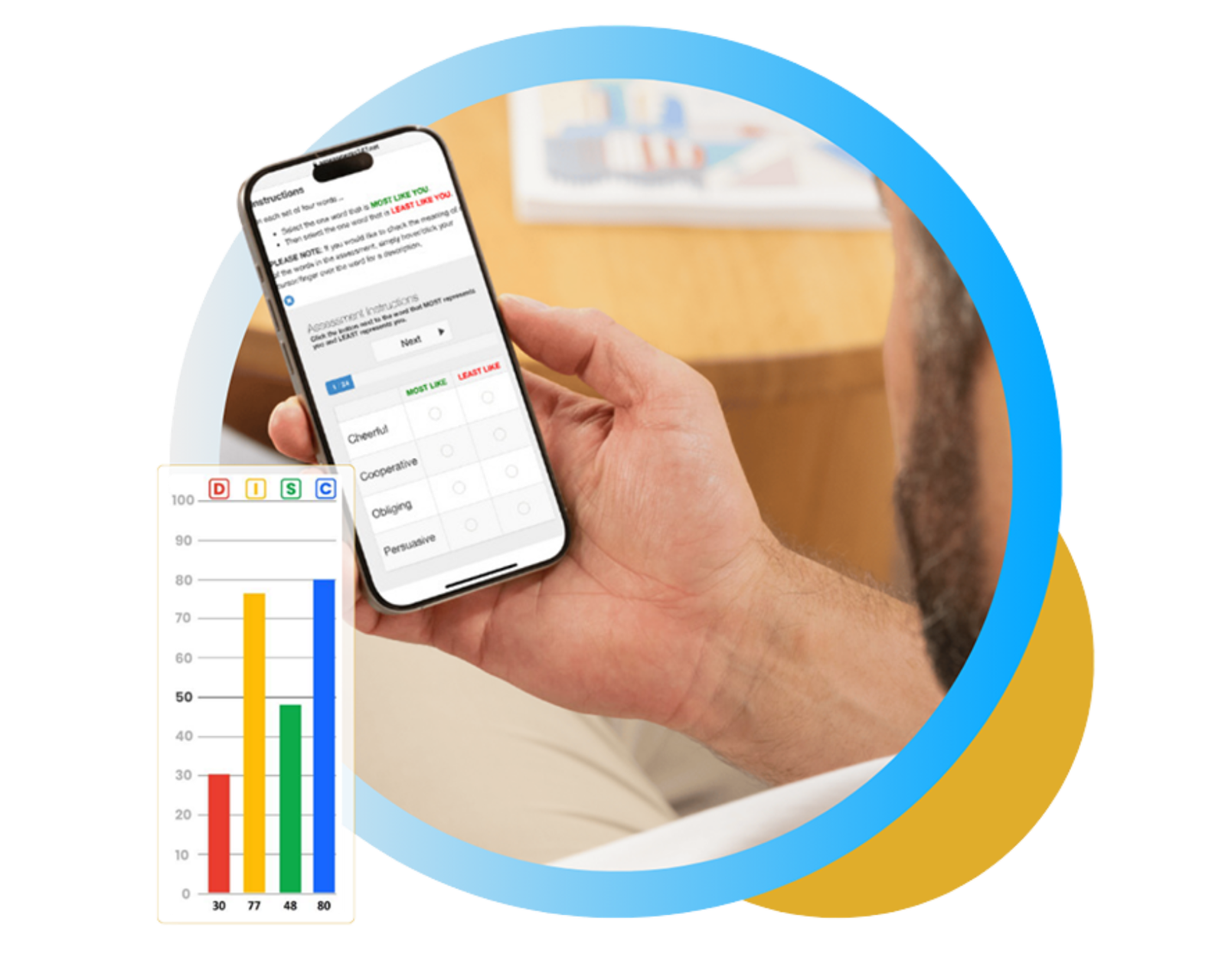
Take The DISC Assessment

Answer focused questions to map your natural and adaptive style. See strengths, stress triggers, and quick wins for communication.

Connect Roles & Relationships

Learn how to flex with different stakeholders, managers, and teams. Identify environments and responsibilities that fit how you operate.

Design Your Communication Plan

Turn insight into daily practices. Set meeting norms, feedback preferences, and “do more / do less” moves that remove friction and build trust.

What does DISC measure?

DISC looks at what people can see. It focuses on your day-to-day behaviors and the emotions behind them. It does not judge your intelligence, education, experience, aptitude, mental health, or personal values.

You will see how you respond to pressure and problems, how you influence and connect with others, the pace you prefer, and how much structure and direction you like.

Once you see these patterns, you can lean into your strengths and adjust the areas that get in the way. Your message lands more clearly, relationships improve, and your work moves with less friction.

A DISC report has three parts
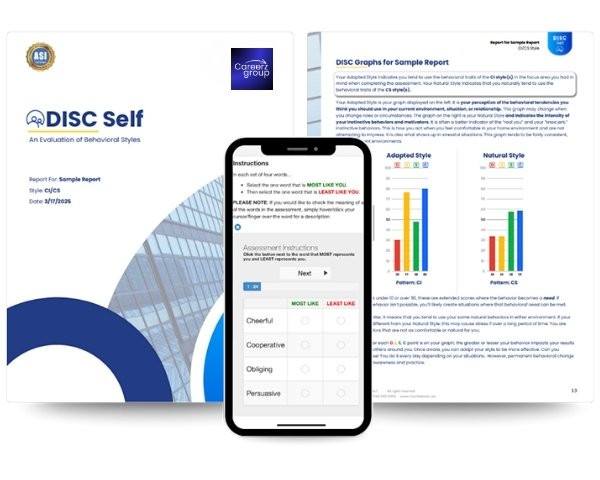

Part 1: Foundations

You learn what each DISC style means and how to spot the core patterns. The model gives you a solid base in directness, openness, pace, priority, and the typical emotions linked to each style.

Part 2: Your unique blend
You get insights about what makes your style distinct. The report includes narratives, visuals, and practical lists such as Communication Do’s and Don’ts, Workplace Tendencies, Potential Areas for Improvement, Stress Responses, and your twelve Behavioral Tendencies at Work. This section is all about you and helps you understand your blend in depth.

Part 3: Adaptability in action
You explore how to flex your style with clear, usable recommendations for you and for people who work with you. It provides tools to practice better communication and to keep building your DISC skills in everyday situations.
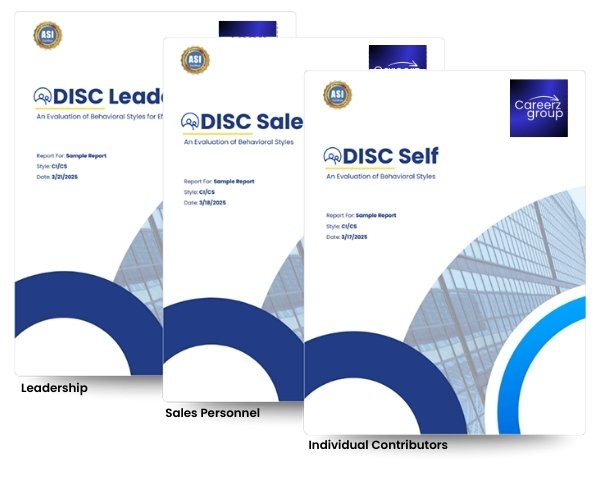
DISC reports can be run by a person’s job role. EG: managers, sales, staff members.

How DISC assessments work

There are no right or wrong answers. You take a short online questionnaire that often takes about ten minutes. Your Natural Style tends to stay steady over time. Your Adapted Style can shift based on your environment, the situation, or the relationship. It reflects this moment in your life. Many people retake DISC after a few years because tools improve and life seasons can change how you show up. You can score and receive your report electronically, and there are paper options as well.

What you do

You read sets of words and choose which are most like you and least like you. An algorithm turns those choices into your personal style blend. Your report explains your tendencies, needs, ideal work environment, and practical ways to adapt with others. You also see your strengths and possible challenges. The report includes a quick tour of the other DISC styles so you can understand how they act and what they may need. Used with a team, this builds shared language and smoother communication.

A note about DISC labels

DISC is not for putting people in boxes. A person with a primary D style will not act the same as every other D. A DC and a DI can look very different. The goal is awareness of communication preferences and priorities, not excuses for poor behavior. Focus on building your DISC skills in everyday situations—listen for style cues, flex your approach, and meet people where they are. That’s how you turn four letters into better conversations, stronger teams, and real results.

Passionate – Dedicated – Professional

latest news & insights

We connect real-world labor trends, human behavior, and practical tools so students, parents, and professionals can make smarter decisions about work.
Every post is built to turn confusion into clarity and “someday” ideas into next steps you can act on today.

We couldn’t have said it better

what people are saying

Real stories from students, professionals, and organizations who discovered clarity, confidence, and purpose with the JPTI™.

Smoother Communication

“Before DISC, I assumed everyone heard things the way I do. Now I know when to be patient, when to be direct, and how to meet people where they are. Projects feel smoother and life at home is easier.”

Alyssa P. | St. Petersburg, FL

Spot Style Differences

“DISC gave me words for things I felt but could not explain. I can spot different styles, choose my approach, and build trust faster. Communication is clearer with my team and with my family.”

Rosemary P. | Clearwater, FL

Improved Sales Conversations

“DISC helped me get out of my own way. I understand how I come across and how others like to communicate. I slow down, read the room, and adjust. It has improved my work conversations and my relationships at home. And best of all, my sales performance.”

Jennifer O. | Southfield, MI

Like A Crystal Ball

“It’s like my own crystal ball. I can quickly spot style differences and know how I should approach people differently. I didn’t realize what I was doing wrong. Now I do! I was able to have courageous conversations with my boss and became a trusted advisor.”

David K. | Poughkeepsie, NY