OEJTS | Open Extended Jungian Type Scales
MBTI | Myers-Briggs Type Indicator
MBTI | Myers-Briggs Type Indicator
Clarify your personality preferences across four areas so you understand
how you take in information, make decisions, and work with others.
Improve
Self-awareness
Better
Communication
Smarter Stress
Management
What is the difference between OEJTS and MBTI?
OEJTS stands for Open Extended Jungian Type Scales. It is an open-source, Jungian-style personality assessment designed as an alternative to the Myers-Briggs Type Indicator. Like MBTI, it uses four preference pairs: Extraversion-Introversion, Sensing-Intuition, Thinking-Feeling, and Judging-Perceiving. The OEJTS was developed by selecting items that helped distinguish between people who already identified with different Myers-Briggs-style personality types.
MBTI stands for Myers-Briggs Type Indicator. It is the official, trademarked personality assessment based on the Myers-Briggs framework. The names MBTI, Myers-Briggs, and Myers-Briggs Type Indicator are trademarks of the Myers & Briggs Foundation.
The practical difference is this: OEJTS is a free open-source way to explore Jungian type preferences, while MBTI refers to the official Myers-Briggs instrument. Both can help you think about personality preferences, communication style, decision-making, and work style. But neither should be treated as a complete career-fit answer by itself.
At Careerz Group, we use these personality insights as one part of a broader process. They can help explain how you tend to operate, but career clarity also requires looking at work-fit, values, motivators, skills, strengths, energy patterns, goals, and the real demands of the role.
OEJTS and MBTI-style insights
| Category | OEJTS | MBTI |
|---|---|---|
| Full name | Open Extended Jungian Type Scales | Myers-Briggs Type Indicator |
| Type | Open-source Jungian-style personality assessment | Official trademarked Myers-Briggs assessment |
| Framework | Based on Jungian personality type preferences | Based on Myers-Briggs personality type preferences |
| Output | Four-letter type similar to MBTI-style results | Official MBTI four-letter type |
| Best use | Exploring personality preferences and self-awareness | Structured personality insight, often used in coaching, teams, and development |
| Careerz Group stance | Useful input, not a complete answer | Useful input, not a complete answer |
| Note of caution | Should not be presented as official MBTI | Should not be used as the sole basis for career or hiring decisions |
How these assessments fit in the Careerz Group process
Careerz Group may use Jungian-style personality insights, including OEJTS and MBTI-style frameworks, to help individuals better understand communication, decision-making, energy, and work preferences. OEJTS is an open-source alternative based on similar Jungian type dimensions. MBTI is the official trademarked Myers-Briggs Type Indicator.
These tools are helpful, but they are not the whole career answer. Personality can explain how you tend to operate. Career satisfaction is also highly influenced by “fit” which requires understanding what drives you, what work energizes you, what environments support your best performance, and what roles align with your values, skills, and goals.

Why use OEJTS or MBTI in career planning?
OEJTS and MBTI-style assessments are useful in career planning because they help people understand how they naturally prefer to think, communicate, make decisions, process information, manage structure, and interact with others.
That matters because career fit is not just about skills. Two people can have the same degree, résumé, or technical ability and experience work very differently depending on their personality preferences, energy patterns, communication style, decision-making approach, and tolerance for structure or ambiguity.
Careerz Group offers the OEJTS, or Open Extended Jungian Type Scales, as a free starting point because it gives people a practical, low-barrier way to explore Jungian-style personality preferences. OEJTS was developed as an open-source alternative to the Myers-Briggs Type Indicator and measures the same four broad dichotomies: Introversion-Extraversion, Sensing-Intuition, Feeling-Thinking, and Judging-Perceiving.
We also value the MBTI framework because it has helped millions of people build language around personality type, communication, teamwork, leadership, learning, and career change. The official Myers-Briggs Foundation describes the MBTI preference pairs as Extraversion-Introversion, Sensing-Intuition, Thinking-Feeling, and Judging-Perceiving, and also notes that type can support career choice and career transitions.
For clients who want more than a free starting point, For clients who want deeper insight, Careerz Group also offers paid personality deep dives using advanced personality reports and partner tools, including 16Personalities-style resources where appropriate. That deeper work helps turn a four-letter result into practical insight: how you work best, where you may feel drained, how you communicate under pressure, what kinds of environments may support you, and what role conditions may create friction.
The key is not to treat OEJTS, MBTI, or 16Personalities as a complete career answer. Even 16Personalities states that personality is only one factor that guides behavior and that its model uses the Myers-Briggs acronym format but defines personality through its own NERIS framework, which is influenced by Big Five trait dimensions.
Careerz Group uses these tools as one layer in a broader career-fit process. Personality can help explain how you tend to operate. But better career planning also requires understanding your work-fit, values, motivators, strengths, skills, interests, goals, energy patterns, and the real demands of the role.
The goal is not to chase a personality label. The goal is to make better career decisions with clearer self-awareness and fewer wrong turns.

MBTI™ (Personality Assessment)
Discover your personality blueprint and how it shapes your world
What it does
The Myers-Briggs Type Indicator (MBTI) identifies personality preferences across four dimensions: Extraversion–Introversion, Sensing–Intuition, Thinking–Feeling, and Judging–Perceiving. It provides insight into how you process information, make decisions, and interact with others helping you better understand both yourself and those around you.
What you’ll gain
> Recognize your natural preferences and strengths
> Improve teamwork by appreciating different personality types
> Make more confident decisions aligned with your personality style
What are the four MBTI preference pairs?
The MBTI and OEJTS frameworks look at four personality preference pairs:
- Extraversion or Introversion: where you tend to focus your energy.
- Sensing or Intuition: how you tend to take in information.
- Thinking or Feeling: how you tend to make decisions.
- Judging or Perceiving: how you tend to approach structure, planning, and flexibility.
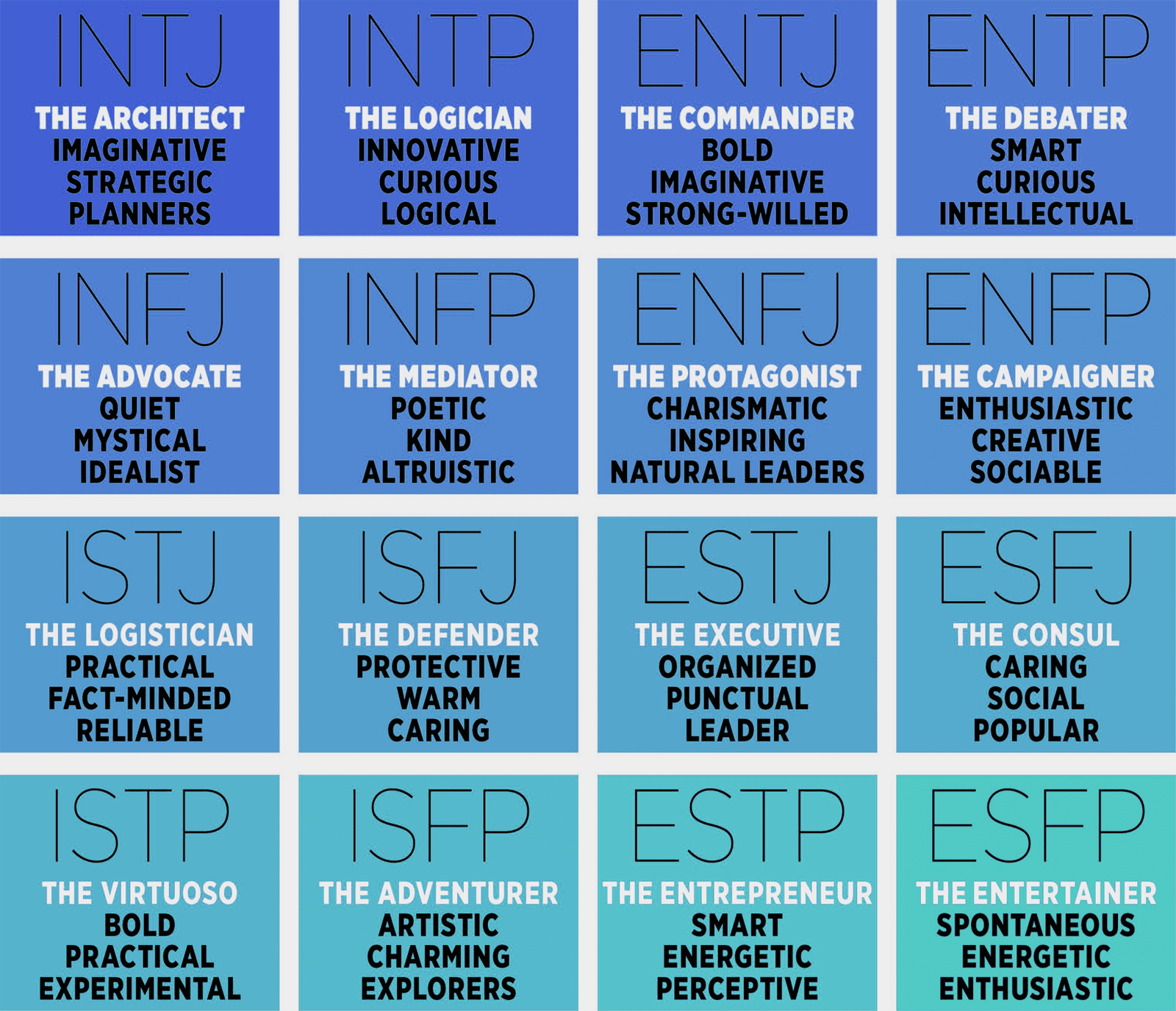
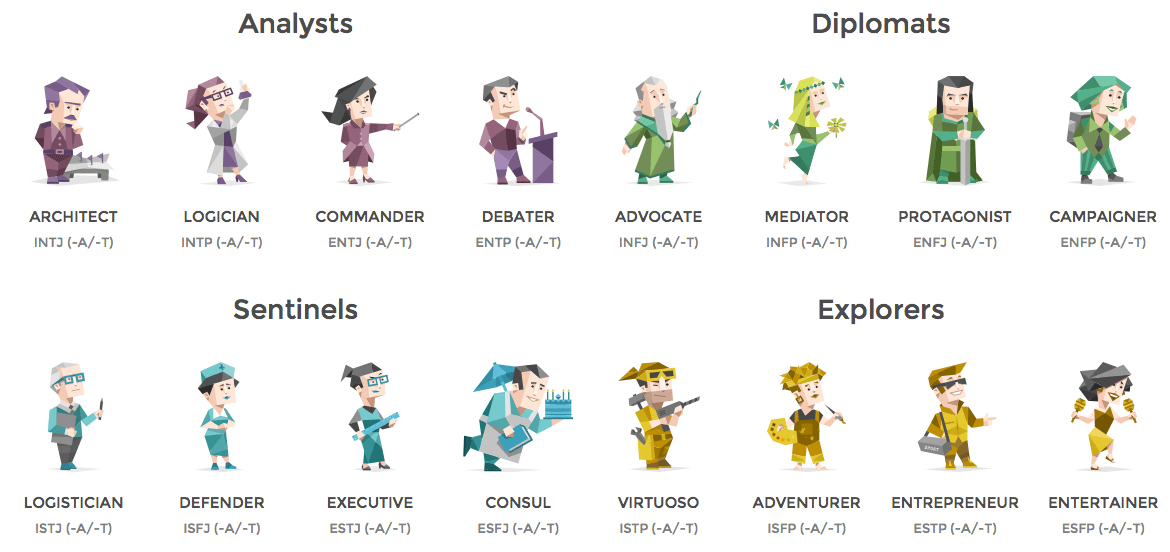
Together, these preferences create a four-letter type, such as ENFP, ISTJ, ENTJ, or ISFP. These types are often shown visually in diagrams to help people understand common personality patterns more easily.
At Careerz Group, we use these preferences to help people recognize patterns in how they communicate, make decisions, respond to structure, and interact with others. The goal is not to box someone into a fixed type or career path. The goal is to give people practical language for understanding themselves and others.
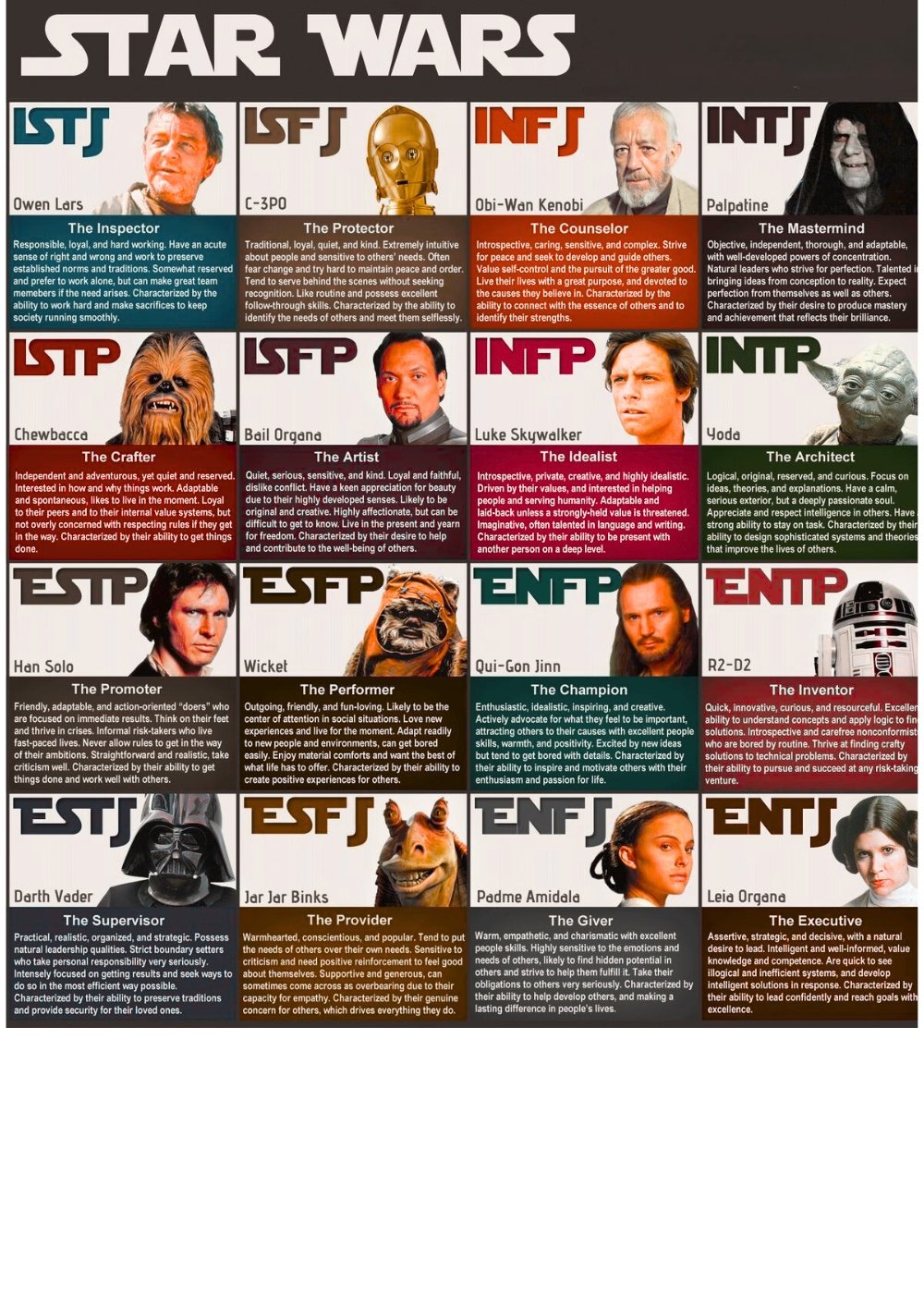
Sometimes it can be helpful to associate certain personality patterns with familiar fictional characters, public figures, or well-known examples. That does not mean a person is exactly like that character or celebrity. It simply makes the preferences easier to recognize and remember.
For example, once you learn to spot stronger Thinking or Feeling tendencies, you can communicate more effectively. In a job interview, a Thinking-oriented person may respond better to logic, evidence, results, and clear reasoning. A Feeling-oriented person may pay closer attention to values, impact, relationships, and how decisions affect people.
Neither style is better. They are different preferences. When you understand the difference, you can tailor how you interview, collaborate, lead, coach, or communicate with a colleague, manager, client, or team.
Comparing the 4 preference pairs of OEJTS and MBTI
| Preference Pair | What it looks at | Same in OEJTS and MBTI? |
|---|---|---|
| Extraversion / Introversion | Where you tend to focus energy. Outer world vs. inner world. | Yes |
| Sensing / Intuition | How you tend to take in information. Facts/details vs. patterns/possibilities. | Yes |
| Thinking / Feeling | How you tend to make decisions. Objective logic vs. people/values impact. | Yes |
| Judging / Perceiving | How you tend to approach structure. Planned/decided vs. flexible/adaptive. | Yes |
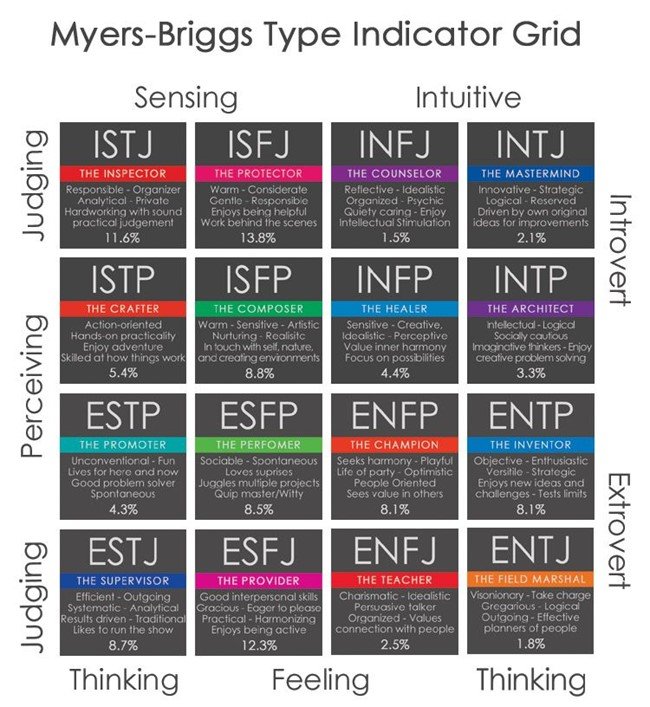
MBTI Types at a Glance
This grid shows the 16 Myers-Briggs personality types. Each square combines four preferences: where you focus energy (Extraversion or Introversion), how you take in information (Sensing or Intuition), how you decide (Thinking or Feeling), and how you like to organize life (Judging or Perceiving).
- The top half highlights introverted types, the bottom half extroverted types.
- The left side leans Sensing, the right side Intuitive.
Each tile lists the four-letter code, a nickname, key traits, and approximate frequency.
Use it as a quick guide to communication and work style preferences, not as a measure of skill or ability.
Putting a Face to a Name
Sometimes it’s easier to think of historical figures or famous movie characters to help remember the basic personality of each “TYPE”.

Every Type indicator can be described in different ways.
MBTI “types” are best understood as four sliding preferences, not four hard labels. Each letter is a shorthand for where someone tends to land on a spectrum. More inward or more outward (I/E). More concrete or more pattern-seeking (S/N). More analytical or more values-led (T/F). More structured or more adaptive (J/P).
That’s why you’ll see MBTI taught through lots of different grids and metaphors. Star Wars characters, famous leaders, color systems, communication styles, team roles.
They’re all lenses on the same idea: people reliably differ in what they notice first, how they decide, and how they operate under pressure. The goal is not to “box” anyone. It’s to make differences visible enough to reduce misreads, stop taking behavior personally, and build better working agreements across a team’s natural diversity.