
The Big Five
A blueprint for understanding the main dimensions of your personality.
openness
conscientiousness
extraversion
agreeableness
neuroticism

What you can gain from taking the Big Five Test
-
Your trait profile. A plain-language snapshot of where you score on Openness, Conscientiousness, Extraversion, Agreeableness, and Neuroticism, often with percentiles for context.
-
What it means day to day. Likely strengths, blind spots, and how you tend to communicate, decide, collaborate, and react under stress.
-
Fit and next steps. The environments and habits that help you thrive, plus practical tips to improve focus, relationships, and well-being.
The traits that make up your personality shape how you feel about being around other people or being alone in different settings. Contemporary personality psychologists assert that human personality has five essential aspects, referred to as the Big Five personality traits.
The five-factor model, commonly known as the Big 5 personality qualities, includes agreeableness, openness, conscientiousness, emotional stability (neuroticism), and extraversion (which many people spell extroversion).
Extraversion is defined by sociability, agreeableness is defined by kindness, openness is defined by creativity and intrigue, conscientiousness is defined by thoughtfulness, and neuroticism is defined by melancholy or emotional instability. You can learn about your own personality traits without taking a personality test if you know what they are and how high or low their scores are.
This knowledge helps you better understand how people behave based on where they fall on the personality trait continuums.
ABOUT THE BIG FIVE TEST: The test consists of fifty items that you must rate on how true they are about you on a five point scale where 1=Disagree, 3=Neutral and 5=Agree.
It takes most people 3-8 minutes to complete.
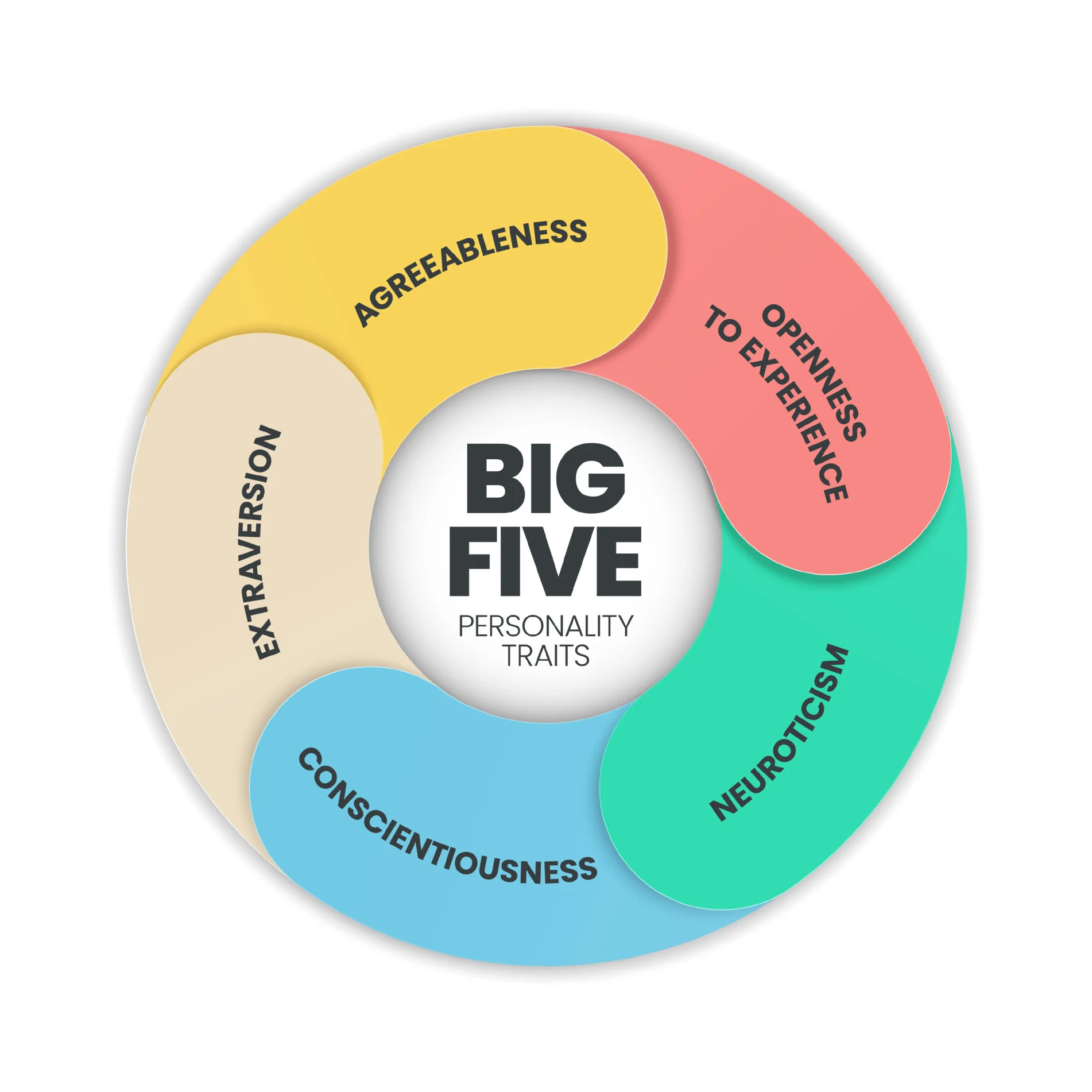
Need help remembering exactly what the five traits are? Some use the acronyms:
- OCEAN (openness, conscientiousness, extraversion, agreeableness, and neuroticism) to remember the Big 5 personality traits.
- CANOE (for conscientiousness, agreeableness, neuroticism, openness, and extraversion) is another option.
The Big 5 Personality Traits
It is important to note that each of the five primary personality traits represents a range between two extremes. For example, extraversion represents a continuum between extreme extraversion and extreme introversion. In the real world, most people lie somewhere in between.
While there is a significant body of literature supporting these primary personality traits, researchers don’t always agree on the exact labels for each dimension. That said, these five traits are usually described as follows.
abstract thinking.

Openness
Openness (also referred to as openness to experience) emphasizes imagination and insight the most out of all five personality traits.1 People who are high in openness tend to have a broad range of interests. They are curious about the world and other people and are eager to learn new things and enjoy new experiences.
People who are high in this personality trait also tend to be more adventurous and creative. Conversely, people low in this personality trait are often much more traditional and may struggle with abstract thinking.
High
- Spends time preparing
- Finishes important tasks right away
- Pays attention to detail
- Enjoys having a set schedule
Low
- Dislikes structure and schedules
- Makes messes and doesn’t take care of things
- Fails to return things or put them back where they belong
- Procrastinates important tasks
- Fails to complete necessary or assigned tasks

Conscientiousness
Conscientiousness is defined by high levels of thoughtfulness, good impulse control, and goal-directed behaviors.1 Highly conscientious people tend to be organized and mindful of details. They plan ahead, consider how their behavior affects others, and are conscious of deadlines.
If a person scores low on this personality trait, it might mean they are less structured and organized. They may procrastinate when it comes to getting things done, sometimes missing deadlines completely.
High
- Spends time preparing
- Finishes important tasks right away
- Pays attention to detail
- Enjoys having a set schedule
Low
- Dislikes structure and schedules
- Makes messes and doesn’t take care of things
- Fails to return things or put them back where they belong
- Procrastinates important tasks
- Fails to complete necessary or assigned tasks

Extraversion
Extraversion (or extroversion) is a personality attribute that includes being excited, social, talkative, forceful, and emotionally expressive.
Heritability estimates of the Big Five personality traits derived from common genetic variations. Extroverts are gregarious people who get energy from being around other people. Being with other people makes them feel more alive and energetic.
People that are low in this personality attribute (or introverted) are usually more reserved. They do not have as much energy when they are with other people, and social gatherings might be tiring. Introverts often need time alone and quiet to “recharge.”
High
- Enjoys being the center of attention
- Likes to start conversations
- Enjoys meeting new people
- Has a wide social circle of friends and acquaintances
- Finds it easy to make new friends
- Feels energized when around other people
- Say things before thinking about them
Low
- Prefers solitude
- Feels exhausted when having to socialize a lot
- Finds it difficult to start conversations
- Dislikes making small talk
- Carefully thinks things through before speaking
- Dislikes being the center of attention

Agreeableness
This personality trait encompasses characteristics such as trust, generosity, friendliness, affection, and many prosocial actions.
Estimates of the heritability of the Big Five personality traits based on shared genetic variations. People who are agreeable are more likely to work together, whereas people who are not are more likely to be competitive and even manipulative.
High
- Has a great deal of interest in other people
- Cares about others
- Feels empathy and concern for other people
- Enjoys helping and contributing to the happiness of other people
- Assists others who are in need of help
Low
- Takes little interest in others
- Doesn’t care about how other people feel
- Has little interest in other people’s problems
- Insults and belittles others
- Manipulates others to get what they want

Emotional Stability (Neuroticism)
Neuroticism is a personality attribute that includes being melancholy, moody, and emotionally unstable. People usually think of this attribute as a bad personality trait that might hurt a person’s life and health. People that are really neurotic tend to have mood swings, anxiety, impatience, and melancholy.
People who do not have this personality feature tend to be more stable and able to handle stress.
High
- Experiences a lot of stress
- Worries about many different things
- Gets upset easily
- Experiences dramatic shifts in mood
- Feels anxious
- Struggles to bounce back after stressful events
Low
- Emotionally stable
- Deals well with stress
- Rarely feels sad or depressed
- Doesn’t worry much
- Is very relaxed
Positive Personality Traits
Positive personality traits are traits that can be beneficial to have. These traits may help you be a better person or make it easier to cope with challenges you may face in life. Personality traits that are considered positive include:
- Adaptable
- Ambitious
- Considerate
- Cooperative
- Friendly
- Gracious
- Humble
- Insightful
- Objective
- Optimistic
- Respectful
- Steady
- Thorough
- Well-rounded
Negative Personality Traits
Negative personality traits are those that may be more harmful than helpful. These are traits that may hold you back in your life or hurt your relationships with others. (They’re also good traits to focus on for personal growth.) Personality traits that fall in the negative category include:
- Aggressive
- Arrogant
- Cold
- Deceptive
- Egotistical
- Guarded
- Intolerant
- Judgmental
- Moody
- Neglectful
- Pompous
- Selfish
- Unreliable
- Withdrawn
What are the Four Most common big 5 types?
The Big 5 personality model is not a typology system, so there are no specific “types” identified. Instead, these dimensions represent qualities that all people possess in varying amounts. One study found that most people do tend to fall into one of four main types based on the Big 5 traits:
- Average: the most common type, characterized by high levels of extroversion and neuroticism and low levels of openness
- Self-centered: high in extroversion and low in conscientiousness, openness, and agreeableness
- Reserved: low on extroversion, neuroticism, and openness, and high on conscientiousness and agreeableness
- Role models: high on every Big 5 trait other than neuroticism
Things That Affect Personality Traits
Studies indicate that both biological and environmental factors contribute to the formation of our personalities. Research on twins indicates that both genetic and environmental factors contribute to the development of the five personality traits.
One earlier study examined the genetic and environmental foundations of the five qualities by analyzing 123 pairs of identical twins and 127 pairs of fraternal twins. The results indicated that the heritability of each personality trait was 53% for extraversion, 41% for agreeableness, 44% for conscientiousness, 41% for neuroticism, and 61% for openness.
Recent study indicates that genetics influence personality; nevertheless, pinpointing specific genes and gene patterns is intricate and complicated. (Source: Translational Psychiatry)
Longitudinal research indicates that these Big Five personality traits generally exhibit considerable stability throughout maturity. A four-year study of working-age adults indicated that personality exhibited few changes due to unpleasant life circumstances.
Research indicates that maturation may influence the five personality traits. People tend to grow less outgoing, less anxious, and less open to new experiences as they get older. On the other hand, agreeableness and conscientiousness tend to get up as people get older. (Source: Cooper, Balisis & Oltmanns research)