

Retention Starts With Fit. Not Perks.
Right People. Right Seats. Right Now.
For fast-growing companies, the biggest HR problem is not finding people. It is keeping the right ones and making sure they are in roles that fit how they are wired.
Inc.’s annual CEO Survey shows the shift. Among this year’s Inc. 5000, 59 percent put retaining their best employees in their top three HR priorities. Only 46 percent ranked recruiting that high. After that came upskilling and training (45 percent), employee engagement (43 percent), employee well-being (22 percent), and health care costs (12 percent).
Why the focus on keeping people instead of only adding them? Leaders are feeling the cost of churn and burnout. They also know how hard it is to replace people who carry the company’s story in their heads. As HR expert Tami Nutt of Aspect43 puts it, long-time team members hold the history and unwritten rules of the business. You cannot teach that from a handbook.
Some CEOs are trying new ways to make work feel worth staying for. Emily LaRusch, CEO of Back Office Betties, asks employees to share a list of their personal dreams and goals. When someone hits a major milestone at work, her company picks one dream and helps make it real. That might mean a trip or an art class they have always wanted to take. It is a simple way to say, “You matter as a person, not just a job title.”
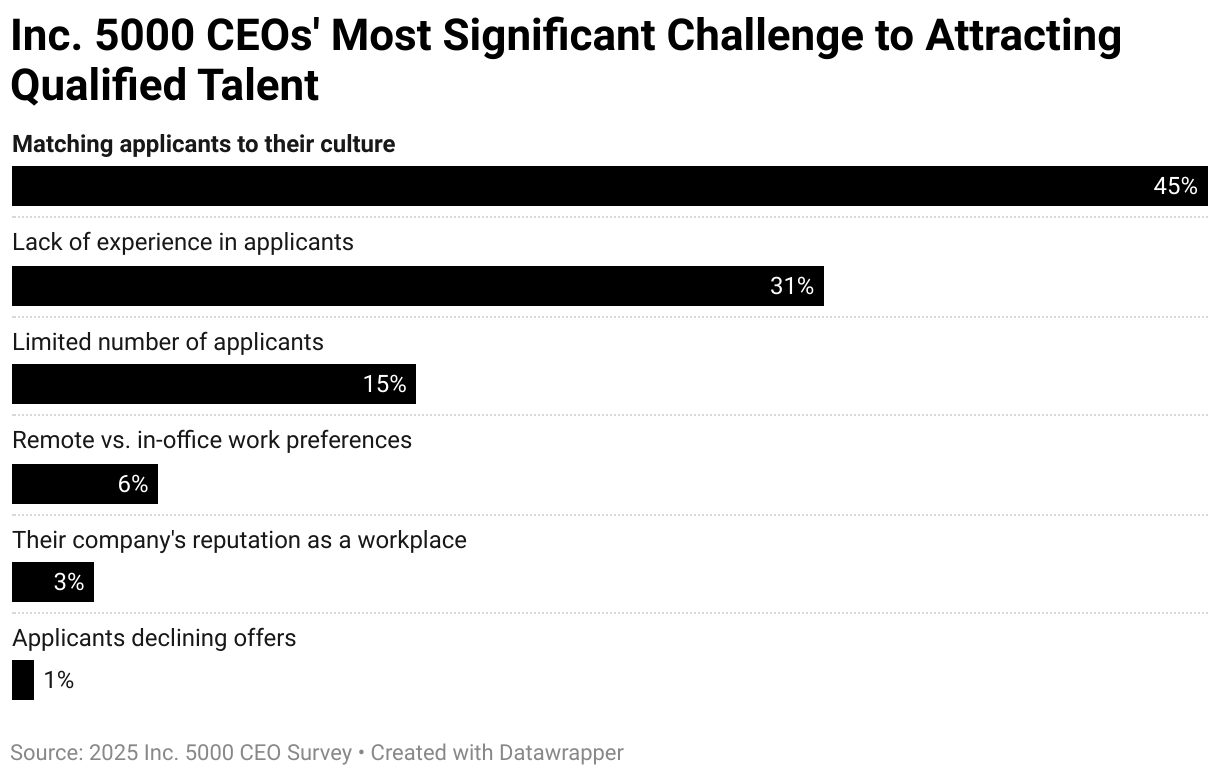
Still, culture and burnout are where many companies stumble. Forty-five percent of Inc. 5000 CEOs say their hardest hiring challenge is finding people who fit how the company works. At the same time, 49 percent say their workforce’s biggest problem is burnout. If you put people in the wrong roles, or in companies whose values clash with their own, you pay for it later in stress, mistakes, and exits.
Job Passion First: A Simple Way to Cut Burnout and Turnover.
This is where a tool like the Job Passion Type Indicator (JPTI™) comes in. Instead of looking only at skills and past roles, JPTI maps what kind of work gives someone energy, how they prefer to contribute, and what drains them fastest. It gives a shared language for “right person, right seat, right reasons.”
Used in hiring, JPTI helps CEOs and HR teams see beyond a resume. Two candidates may have the same skills. One lights up when they solve messy problems with people. The other prefers deep focus and clear rules. If your company’s core values prize ownership, feedback, and shared problem-solving, you want the person whose passion lines up with that way of working, not just the one who looks good on paper.
Used with current staff, JPTI can help managers move people into roles that fit them better instead of losing them. A top performer who is burning out might not be “done.” They might be stuck in a seat that fights their natural style every day. When you see their passion profile, you can shift responsibilities, adjust goals, or redesign the team so their daily work matches what they care about and how your company operates.
At the team level, JPTI helps you see where your culture is strong and where it is thin. You can compare how people like to work with the values on the wall. If you say you value creativity and ownership, but most of your key roles are filled by people who prefer stability and clear direction, that gap explains a lot about slow decisions and quiet frustration.
Retention, culture fit, and burnout are not three separate problems. They are three signals of the same thing. Do we know our people well enough to put them in roles that fit who they are and what the company stands for. Tools like JPTI give CEOs a practical way to do that, one hire and one team at a time, so they can keep the people they already trust and build a company that lasts long enough to win.
Share this article
Follow us
A quick overview of the topics covered in this article.