
Game Dev Portfolio Guide
A straight-talk guide for students and early-career professionals breaking into the gaming industry.
Here’s The Hard Truth Nobody Tells You
Let’s cut through the noise.
You’ve spent years grinding through school, obsessing over your GPA, maybe even racking up student debt for that game design degree. You’ve been told that good grades open doors. That the right credential gets you hired.
In the gaming industry? That’s not how it works.
We’ve worked with tens of thousands of aspiring game developers through our Game Careerz assessments. We’ve seen brilliant students with 4.0 GPAs get passed over. We’ve watched self-taught creators with no formal education land dream jobs at studios they idolized.
The difference? Their portfolio.
“Show me what you’ve made, not what you’ve memorized.”
— Every hiring manager in games, ever
Your portfolio isn’t just a collection of your work. It’s your proof. Your evidence. Your answer to the only question that matters: Can you actually do this job?
Why Portfolios Beat Resumes in Games
The gaming industry operates differently than traditional corporate careers. Here’s why:
Games Are Built by Makers, Not Test-Takers
A studio doesn’t care if you can pass an exam on level design theory. They care if you can build a level that’s fun to play. They don’t want to know you studied character rigging—they want to see a character rig that moves beautifully.
The Numbers Are Brutal
For every open position at a major studio, there are often hundreds of applicants. Recruiters spend an average of 6-10 seconds on an initial resume scan. But a stunning portfolio piece? That stops the scroll. That gets forwarded to the art director. That starts conversations.
Hiring Managers Are Looking for Risk Reduction
Every hire is a gamble. Studios are asking themselves: Will this person deliver quality work on deadline? Your portfolio answers that question before you ever step into an interview.
| What Resumes Tell Them | What Portfolios Tell Them |
|---|---|
| Where you went to school | How you think and solve problems |
| Job titles you’ve held | The actual quality of your work |
| Skills you claim to have | Skills you demonstrably possess |
| That you exist | That you can do the job |
Portfolio Essentials by Role
Not all portfolios are created equal. What you showcase depends entirely on what you want to do. Let’s break it down by role.
Game Designers
What studios want to see: Your ability to create engaging, balanced, and well-documented game systems. They want evidence that you understand player psychology, can iterate on feedback, and communicate your ideas clearly.
Portfolio must-haves:
- Game Design Documents (GDDs): Well-structured, clear, visually organized
- Playable prototypes: Even rough ones built in Unity, Unreal, or Godot
- System breakdowns: Analyze existing games or showcase your own mechanics
- Process documentation: Show how you iterated from concept to final design
- Exemplary portfolios to study:
| Designer | What Makes It Work |
|---|---|
| Tristan Özkan | Clean presentation, clear role descriptions, diverse project types |
| Sandrine le Comte | Strong visual hierarchy, accessible documentation |
Pro tip: Game design is often the hardest role to break into because everyone thinks they have “great ideas.” Your portfolio must prove you can execute ideas, not just have them. Playable prototypes (even ugly ones) speak volumes.
Level Designers
What studios want to see: Spatial reasoning, player flow understanding, tool proficiency, and the ability to create memorable spaces that serve gameplay.
Portfolio must-haves:
- Playable levels: In industry-standard engines (Unreal preferred for AAA)
- Blockout/greybox documentation: Show your process before the art pass
- Top-down layouts with annotations: Demonstrate intentional design decisions
- Video walkthroughs: Narrated explanations of your design choices
- Exemplary portfolios to study:
| Designer | Specialty & Strength |
|---|---|
| Hannes Gilles | Clean documentation, strong visual presentation |
| William Fredriksson | Focused project deep-dives with clear breakdowns |
| Paul Svahn Moore | Solid process documentation |
| Shane Canning | Professional presentation, AAA-ready examples |
| Piotr Bednarczuk | Strong multiplayer level design focus |
| Mike Gonthier | Veteran-level presentation and project variety |
| Marloes de Graaf | Excellent breakdown methodology |
| James Walton | Clear navigation and role-specific content |
Pro tip: Many aspiring level designers make the mistake of only showing finished, art-passed levels. Studios actually love seeing your greybox work—it shows you understand that level design is about flow and gameplay, not just pretty environments.
3D Artists
What studios want to see: Technical proficiency, artistic eye, style versatility (or strong specialization), and an understanding of real-time game art constraints.
Portfolio must-haves:
- High-quality renders: First impressions matter enormously
- Wireframes and texture breakdowns: Show your technical chops
- Variety OR deep specialization: Characters, environments, props, or hard surface
- Real-time engine shots: Prove it works in-game, not just in ZBrush
- Exemplary portfolios to study:
| Artist | Known For |
|---|---|
| Helder Pinto | Environment art mastery, Blizzard veteran |
| Tor Frick | Stylized excellence, strong personal brand |
| Clinton Crumpler | Concept and 3D hybrid, stunning visuals |
| Johnson Ting | Character art, industry veteran presentation |
| Pat Dunal | Hard surface and prop excellence |
| Stéphane Charré | Environmental storytelling |
| Airborn Studios | Studio-level team portfolio example |
| Envar Studio | Stylized 3D, character focus |
Pro tip: ArtStation is the industry standard platform for 3D artists. If you’re not on ArtStation, you’re invisible. But don’t only rely on ArtStation. Having your own website shows professionalism and allows you to control the narrative.
Choosing Your Portfolio Layout
Based on our work with thousands of aspiring developers, we’ve identified three proven portfolio structures that work. Your choice depends on your experience level and target role.
Layout 1: Classical
Best for: Those with multiple solid projects to showcase
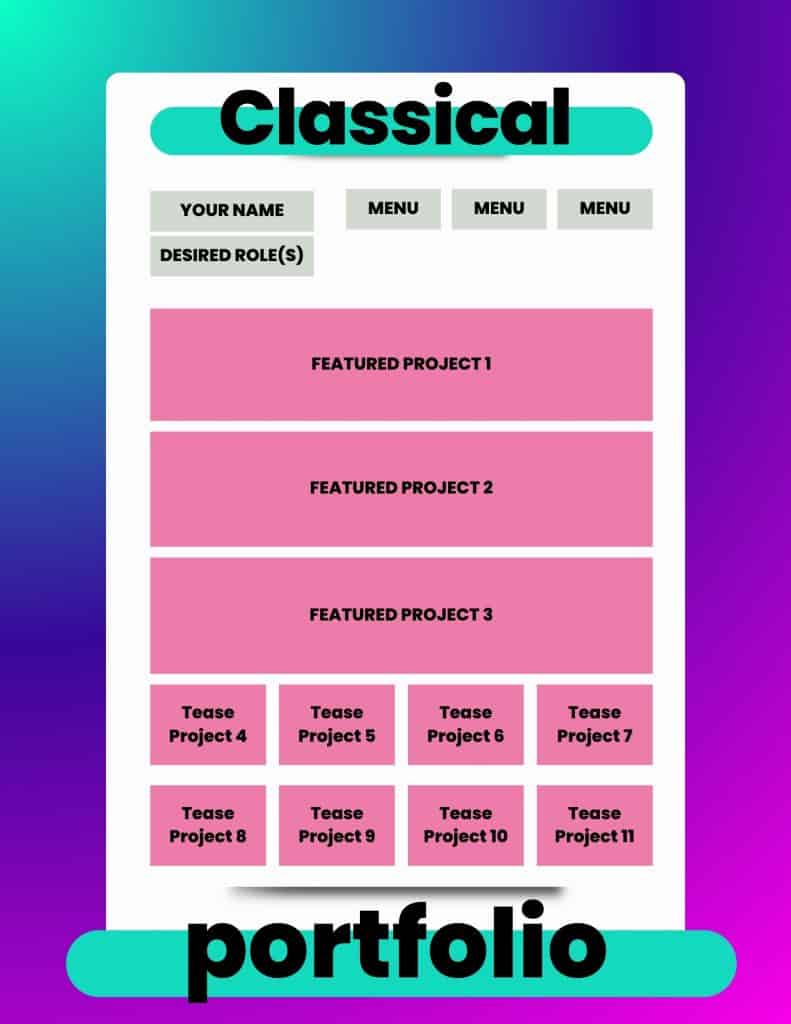
┌─────────────────────────────┐
│ NAME / TARGET ROLE / NAV │
├─────────────────────────────┤
│ [ PROJECT 1 ] │
│ [ PROJECT 2 ] │
│ [ PROJECT 3 ] │
│ … │
│ [proj] [proj] [proj] │
│ [proj] [proj] [proj] │
└─────────────────────────────┘
How it works:
Clean grid or list of projects
Each project links to a detailed breakdown page
Navigation clearly states your name and target role
Projects ordered by strength, not chronology
When to use it: You have 4+ solid projects and want to demonstrate range.
Layout 2: Classical with Key Project
Best for: When you have one standout piece that defines your abilities
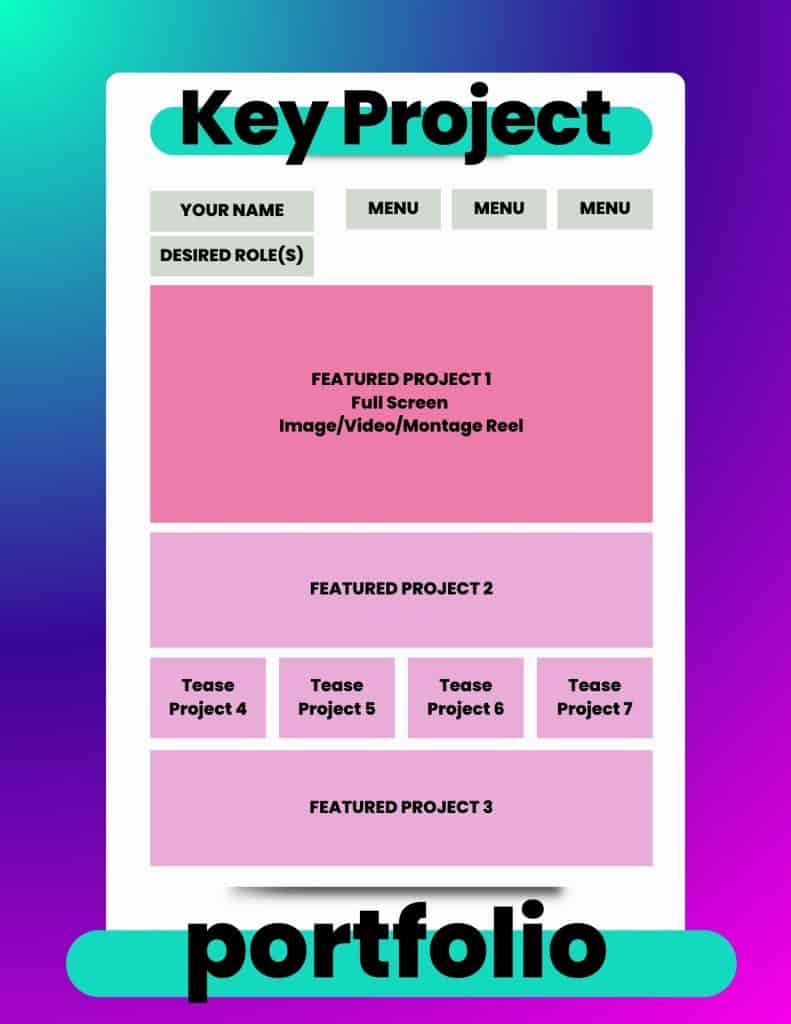
┌─────────────────────────────┐
│ NAME / TARGET ROLE / NAV │
├─────────────────────────────┤
│ │
│ FULL SCREEN HERO PROJECT │
│ (Image/Reel/Video) │
│ [ See Projects ↓ ] │
│ │
├─────────────────────────────┤
│ [ PROJECT ] │
│ [proj] [proj] [proj] │
│ [ PROJECT ] │
└─────────────────────────────┘
How it works:
Hero section immediately showcases your absolute best work
Supporting projects below demonstrate additional skills
The hero piece does the heavy lifting for first impressions
When to use it: You have one project that’s significantly stronger than the rest, or you’re targeting a specific type of role and want to lead with relevant work.
Layout 3: One-Pager
Best for: Early career professionals with fewer but well-documented projects
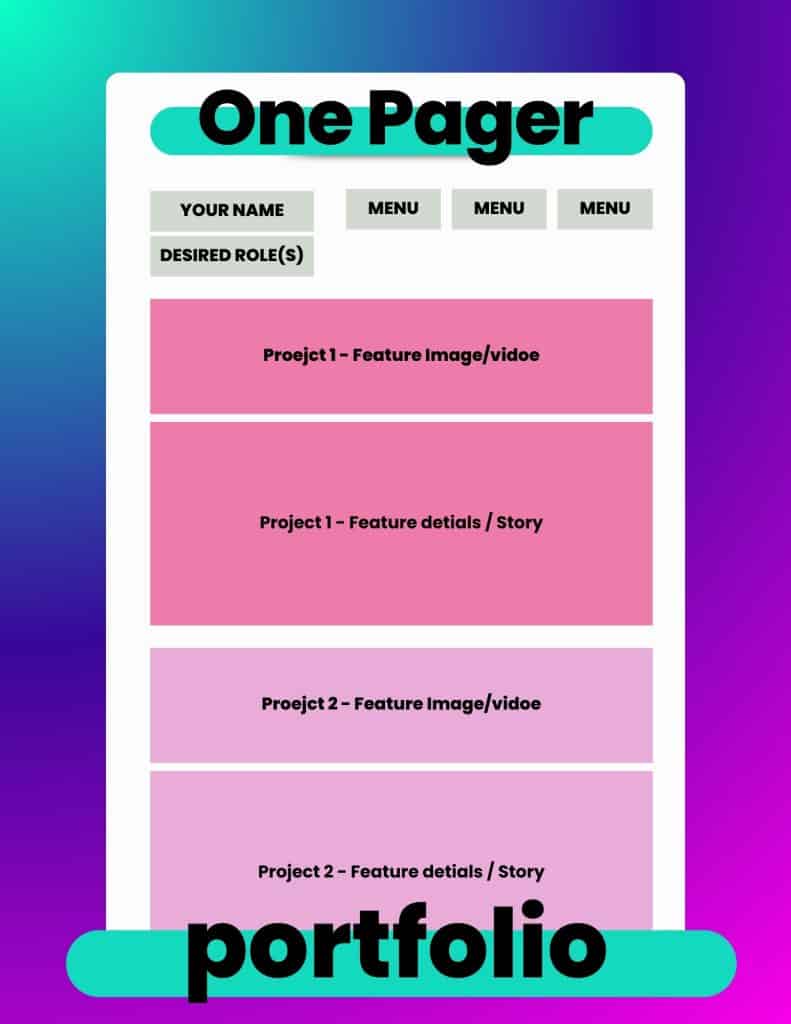
┌─────────────────────────────┐
│ NAME / TARGET ROLE / NAV │
├─────────────────────────────┤
│ [ PROJECT 1 ] │
│ Project Details │
│ & Breakdown │
├─────────────────────────────┤
│ [ PROJECT 2 ] │
│ Project Details │
│ & Breakdown │
│ … │
└─────────────────────────────┘
How it works:
All content on a single scrolling page
Each project includes inline documentation and breakdowns
No separate project pages—everything is accessible immediately
When to use it: You have 2-3 strong projects and want to maximize the depth of presentation for each one. Also effective for mobile-first viewing.
The Non-Negotiable Elements
Regardless of which layout you choose, every portfolio must include:
✅ Clear Role Identification
State what job you want. “Game Designer,” “Environment Artist,” “Level Designer.” Don’t make recruiters guess.
✅ Your Best Work First
Lead with strength. If someone only sees one thing, make sure it’s your best thing.
✅ Context for Each Project
- What was the project?
- What was YOUR role? (Critical for team projects)
- What tools did you use?
- What was the timeline?
- What would you do differently?
✅ Contact Information
Make it stupidly easy to reach you. Email at minimum. LinkedIn helps.
✅ Working Links and Media
Broken links, unplayable builds, and missing images are portfolio killers. Test everything. Then test it again.
Common Portfolio Mistakes (And How to Avoid Them)
We’ve reviewed thousands of portfolios. These mistakes appear constantly:
❌ “Everything I’ve Ever Made” Syndrome
The problem: Including every school project, game jam, and half-finished prototype.
The fix: Curate ruthlessly. 5 strong pieces beat 15 mediocre ones.
❌ No Process Documentation
The problem: Only showing final results with no insight into how you got there.
The fix: Include sketches, blockouts, iteration screenshots, and decision explanations.
❌ Mystery Meat Navigation
The problem: Clever but confusing navigation that leaves visitors lost.
The fix: Clear labels. Obvious structure. Don’t make people work to see your work.
❌ Team Projects Without Role Clarity
The problem: Showing impressive team projects without specifying your contribution.
The fix: Be explicit: “I was responsible for X, Y, and Z. The team handled A, B, and C.”
❌ Outdated Work
The problem: Leading with projects from 3+ years ago that no longer represent your skills.
The fix: If you don’t have recent work, make some. Game jams are your friend.
❌ No Personality
The problem: A portfolio that could belong to anyone.
The fix: Let your voice come through. Brief bio, design philosophy, what excites you about games.
Resources to Level Up Your Portfolio Game
You don’t have to figure this out alone. These communities and resources exist specifically to help:
Learning Resources
| Resource | What It Offers |
|---|---|
| Carbonmade | Portfolio examples across creative fields |
| Map Core | Community portfolio reviews and feedback |
| Level-Design.org | Level design theory, tutorials, and portfolio advice |
| The Design Den (Notion) | Curated resources for game designers |
Communities For Feedback and Support
| Discord Community | Focus |
|---|---|
| ASGC (Always Supporting Games Community) |
Industry networking and job hunting support |
| Funsmith Club | Game design craft and community |
| Games Industry Gathering | Networking community |
| The Design Den | Game design discussion and portfolio feedback |
Pro tip: These Discord servers aren’t just for lurking. Engage. Share your work. Ask for feedback. The connections you make here can lead directly to opportunities.
Your Action Plan: What to Do This Week
Reading about portfolios doesn’t build portfolios. Here’s your homework:
- Day 1-2: Audit
Look at 5 portfolios from the examples above in your target role
Note what works, what doesn’t, what you can learn - Day 3-4: Inventory
List every project you could potentially include
Rank them honestly by quality
Identify your top 3-5 - Day 5-6: Plan
Choose your layout structure
Sketch your portfolio organization
List what’s missing from each project (documentation, screenshots, etc.) - Day 7: Start
Begin with your single strongest project
Create or improve its documentation
Get it online, even if imperfect
“Done is better than perfect. Perfect is the enemy of shipped.”
The Bottom Line
Your degree won’t get you hired. Your GPA won’t get you hired. Your cover letter probably won’t get you hired.
Your portfolio will.
It’s the great equalizer. A self-taught developer with a stunning portfolio will beat a credentialed candidate with a weak one every single time.
The good news? You control this. You can start building today. You can study the examples above, join the communities, get feedback, and iterate.
The gaming industry is brutally competitive. But it’s also remarkably meritocratic. If you can prove you do great work, opportunities will find you.
So stop polishing your resume. Start building your portfolio.
Your work speaks. Make sure it’s saying something worth hearing.
Want to understand where you stand and what roles might fit your skills?
Take the Game Careerz Assessment to get personalized insights that link your personal passion to specific positions within the gaming industry.
Summary: Portfolio Checklist
Use this quick reference as you build:
- Clear target role stated prominently
- 3-6 curated, high-quality projects
- Best work featured first
- Each project includes role, tools, timeline, and learnings
- Process documentation (not just final results)
- Team contributions clearly identified
- Working links and media (tested on multiple devices)
- Easy-to-find contact information
- Mobile-responsive design
- Personal voice/bio included









- Read more: Why you need a portfolio, not just ideas.
- Read more: How to set your career goals
- Read more:How to stand out without shipping games
- Read more:What you learn in school vs. What you need to get hired
- Read more: Why junior design roles are so rare
Read more: 5 Game Design Mistakes and What To Do Instead. - Read more:Why degrees alone don’t get you hired, and what to do about it
- Read more:Why most designers fail game design interviews
- Read more: How to structure your design answers in interviews
- Read more: 3 common soft-skill interview questions
- Read more: Game Dev Portfolio Guide
Additional Resources
- Find Gaming Jobs
- Discord Communities
- Top Game Career Podcasts
- Buy Game Careerz Job Passion Type Indicator (JPTI) Assessment
and find job types and roles that are a perfect fit especially for you.
Share this article
Follow us
A quick overview of the topics covered in this article.
- Why Portfolios Beat Resumes in Games
- Portfolio Essentials by Role
- Choosing Your Portfolio Layout
- Game Careerz 90 Day Plan 2-hour sprints for teens
- 12 Tips for Introverts & Extraverts
- Free Curated Custom GPTs
- Job Scams 2026
- 9 Strategic Ways to Leverage Perplexity Comet in Your Job Hunt
- Why JPTI Is the Missing Link to “Best Fit” Careers
- How values and passions align with career satisfaction and fulfillment
- Key Stats About Career Indecision Among High School Students
- how to avoid expensive college major changes and career regret
- Common Mistakes Students Make Choosing College Majors and Careers
- career exploration frameworks for teenagers before college