
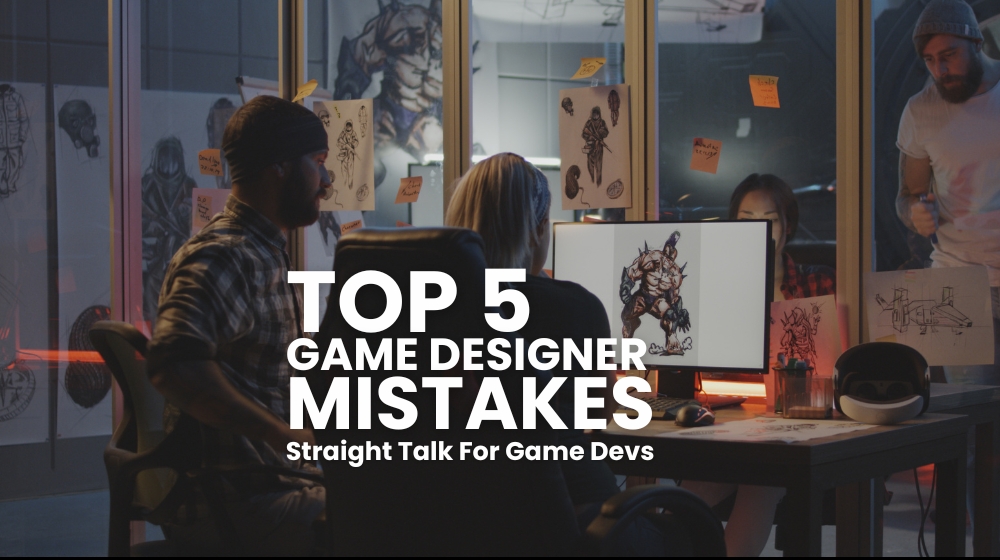
5 Game Design Mistakes That Will Waste You Years
Save yourself the 20+ years of learning. Advice from tenured industry professionals.
We’ve Watched Thousands of Candidates Make the Same Mistakes
Here’s something most people won’t tell you:
The path into game design isn’t complicated. But it is littered with traps. And most aspiring designers fall into the same ones over and over again.
Having helped thousands of candidates get interviews and then hired by gaming studios, we’ve seen patterns. Painful ones. Talented people are burning years on approaches that never work. Passionate designers stuck in loops that go nowhere.
Learning from our community and the misteps of tenured pro’s, this list compiles of 5 common mistakes is designed to save your years of missteps and tips on how to avoid them.
Mistake #1: Thinking Game Design Is About Coming Up With Ideas
This is the big one. The misconception that kills more aspiring careers than any other.
Walk into any game design Discord and you’ll find it: people pitching “revolutionary” concepts. Open-world survival meets deck-building meets dating sim. A game where choices really matter. Something “like Dark Souls but accessible.”
Here’s the uncomfortable truth:
Ideas are worthless without implementation.
Everyone has ideas. Your neighbor has ideas. Your grandma has ideas. The barista who’s “totally going to make a game someday” has ideas.
What almost nobody has? The ability to take an idea and turn it into something real.
Studios don’t hire idea people. They hire people who can:
- Break ideas down into actionable components
- Structure mechanics that support the core experience
- Refine systems through testing and iteration
- Identify problems and solve them systematically
- Communicate decisions clearly to cross-functional teams
That dream concept you’ve been nurturing for years? It means nothing until you can prove you know how to build it—or at least a meaningful piece of it.
What to do instead:
Stop polishing ideas in your head. Start building something—anything—that proves you understand how design actually works. A small, ugly prototype that functions is worth infinitely more than a beautiful 50-page design document that’s never been tested.
Mistake #2: Not Building a Portfolio of Actual Projects
This mistake flows directly from the first one.
You’ve got concepts. Maybe even design documents. You can talk about games intelligently. You understand player psychology and systems thinking.
But where’s the work?
A “brilliant” game concept is still just a concept. Studios want to see what you’ve made.
Let me be blunt: Without a portfolio of actual, tangible projects, you’re invisible to hiring managers. Your resume goes in the pile with hundreds of others. Your cover letter—no matter how well-written—can’t compensate.
What counts as portfolio material:
| Valuable | Less Valuable |
|---|---|
| Playable prototypes | Design documents alone |
| Game jam submissions | Concept pitches |
| Mods for existing games | Feature wishlists |
| Documented level designs | “Coming soon” promises |
| Small finished experiences | Unfinished passion projects |
Mistake #3: Assuming a Degree Is Required (Or Enough)
This mistake operates in two directions, and both are traps.
Trap A: “I can’t break in without a game design degree.”
Wrong. Plenty of successful designers are self-taught. The industry has always valued demonstrated skill over formal credentials. A degree is one path—not the path.
Trap B: “My degree will get me hired.”
Also wrong. And this trap is more dangerous because it costs more money.
A degree might help, but it won’t replace actual experience. Studios look for people who’ve started and finished something. Taking something to completion is your best asset.
| What a degree actually provides | What a degree doesn’t provide |
|---|---|
|
Structure for learning |
Guaranteed employment |
|
Access to mentors and peers |
Portfolio work (unless you’re intentional about it) |
|
Time dedicated to developing skills |
Industry connections (unless you build them yourself) |
|
Potential networking opportunities |
Proof that you can ship |
The uncomfortable reality:
We’ve seen graduates from prestigious programs with nothing to show. No playable work. No documented projects. Just transcripts and debt. They lose positions to self-taught candidates who spent those same years building things.
Conversely, we’ve seen degree-holders who used their time wisely—completing ambitious projects, participating in jams, building genuine portfolios. They do great.
The degree itself is neutral. What you do with that time determines everything.
What to do instead:
If you’re pursuing a degree: Treat it as structured portfolio-building time. Every project should result in something showable.
If you’re not pursuing a degree: Great. You can still learn everything you need. But you must be disciplined and self-directed. Build the portfolio anyway.
Either way, completion is your best asset. Studios trust people who finish things.
Mistake #4: Neglecting Communication and Collaboration Skills
This one surprises people. You’re pursuing a creative, technical discipline—why does “soft stuff” matter?
Because game design isn’t a solo activity.
Game design means constant work with other devs. That’s why studios hesitate to hire candidates without experience.
A game designer’s daily reality involves:
- Communicating design intent to artists, programmers, and producers
- Receiving critical feedback without defensiveness
- Iterating based on input from multiple disciplines
- Defending decisions with clear reasoning
- Compromising when constraints demand it
- Documenting ideas so others can implement them
The cold truth:
A brilliant designer who can’t collaborate is unemployable. A good designer who works well with others is hireable.
Studios aren’t just evaluating your design skills. They’re asking: Will this person make our team better or more difficult?
If you can’t communicate ideas clearly, receive feedback, and iterate with a team, you’ll struggle to get hired.
What to do instead:
Build collaboration experience before you need it professionally:
- Join team game jams. Not solo jams; team jams. Experience the friction of working with others under time pressure.
- Participate in modding communities. Many mods are collaborative. Learn to coordinate with others.
- Practice receiving feedback. Post your work in design communities. Ask for honest critique. Notice your emotional reactions—then learn to manage them.
- Document everything. Practice writing clear design documentation that someone else could implement without you in the room.
When you interview, you’ll be asked about conflict resolution, feedback reception, and teamwork. Have real stories ready, because you’ve actually done it.
Mistake #5: Not Networking With Industry Professionals
Let’s talk about the thing nobody wants to admit:
Hiring isn’t JUST about skill. The easiest way to get hired? Know someone who can vouch for you.
This isn’t unfair. It’s rational.
Studios receive hundreds of applications for each role. Recruiters have seconds to evaluate each one. The safest hire (from their perspective) is someone a trusted employee already knows and recommends.
An internal referral doesn’t guarantee a job. But it guarantees attention. Your application gets seen. Your portfolio gets opened. Your name gets discussed.
That’s the game. And if you’re not playing it, you’re playing at a disadvantage.
What networking actually means:
It doesn’t mean cold-messaging strangers asking for jobs. That’s annoying and ineffective.
It means:
- Engaging genuinely in design communities. Share your work. Give feedback to others. Be helpful.
- Building relationships before you need them. The time to network is when you don’t need anything—not when you’re desperate for a job.
- Being visible. People can’t refer you if they don’t know you exist.
Where to start:
| Community | What It Offers |
|---|---|
| Game jams | Natural relationship-building through collaboration
Here’s a short starter list to consider:
|
| ASGC | Industry networking and job hunting |
| The Design Den | Design discussion and portfolio feedback |
| Professional presence and industry connections (like this content—let’s connect) | |
| Funsmith Club | Game design craft and community |
Find More in our post: Discord Communities
What to do instead:
Start engaging today. Not with asks—with value.
- Comment thoughtfully on design discussions
- Share your work-in-progress (not just finished pieces)
- Give genuine feedback to others
- Participate in jams and credit your teammates
- Show up consistently
When opportunities arise, people will think of you—because they already know your work and your character.
There Are No Shortcuts. But There Is a Path.
I wish I could tell you there’s a hack. A secret door. A way to skip the hard parts.
There isn’t.
But there is a path. It’s not complicated—though it is demanding.
The Path Forward
Start small.
You don’t need to build your dream game. You need to build something. A tiny prototype. A single level. A mechanic that works. Start there.
- Build a prototype.
Stop theorizing. Open an engine. Make something playable. It will be ugly. It will be broken. That’s fine. You’ll learn more in a weekend of building than a month of reading. - Learn by doing.
Every failure teaches something. Every broken mechanic reveals something. Every piece of feedback improves something. The learning is in the doing—not in the planning. - Show your work.
Put it out there. Post it in Discord servers. Share it on itch.io. Write about your process. Yes, it’s uncomfortable. Do it anyway. Visibility creates opportunity. - Iterate.
Your first version will be bad. That’s expected. Take feedback. Make it better. Repeat. The ability to iterate—to improve through cycles—is one of the most valuable skills in design.
And most importantly: keep going.
The designers who break in aren’t always the most talented. They’re the ones who didn’t quit. Who kept building after rejections. Who kept improving after failures.
Persistence (combined with genuine skill development) wins eventually.
Quick Reference: The 5 Mistakes to Avoid
| Mistake | The Reality | What To Do |
|---|---|---|
| Thinking design is about ideas | Ideas without implementation are worthless | Build and refine actual mechanics |
| No portfolio of projects | Concepts don’t get you hired; proof does | Create mods, prototypes, jam games |
| Over-relying on degrees | Credentials don’t replace demonstrated skill | Finish things; show completed work |
| Ignoring soft skills | Design is collaborative; studios hire teammates | Practice communication, feedback, teamwork |
| Skipping networking | Referrals matter; visibility matters | Engage in communities before you need jobs |
The Bottom Line
You don’t need another course. You don’t need a fancier idea. You don’t need permission.
You need to start building.
Every successful game designer I know started the same way: with something small, something imperfect, something that actually existed. They put it out there. They got feedback. They got better. They kept going.
That’s the whole secret. And now you know it too.
Stop making the mistakes that waste years. Start making the work that builds careers.
Ready to understand where you stand and what roles might fit your skills? Take the Game Careerz Assessment to get personalized insights into your path forward.
- About the Author
- Latest Posts

Melissa is the CEO of Careerz Group and author of the Game Careerz series. She builds practical career pathways for Gen Z by linking core values and passions to +3K real job roles across the gaming industry using a data-backed assessment and clear role maps.
Share this article
Follow us
A quick overview of the topics covered in this article.
- We’ve Watched Thousands of Candidates Make the Same Mistakes
- Mistake #1: Thinking Game Design Is About Coming Up With Ideas
- Mistake #2: Not Building a Portfolio of Actual Projects
- Mistake #3: Assuming a Degree Is Required (Or Enough)
- Mistake #4: Neglecting Communication and Collaboration Skills
- Mistake #5: Not Networking With Industry Professionals
- Quick Reference: The 5 Mistakes to Avoid
- The Bottom Line
Latest articles

February 11, 2026
February 11, 2026
- About the Author
- Latest Posts
February 11, 2026
Melissa is the CEO of Careerz Group and author of the Game Careerz series. She builds practical career pathways for Gen Z by linking core values and passions to +3K real job roles across the gaming industry using a data-backed assessment and clear role maps.